

Free Business Guides
What Financial Reports Should I Review Each Month?
At minimum, review the profit and loss statement, balance sheet, cash forecast, receivable aging, near-term obligations, work-level profitability, sales or pipeline, and capacity measures together each month.
What financial reports should a small-business owner review each month?
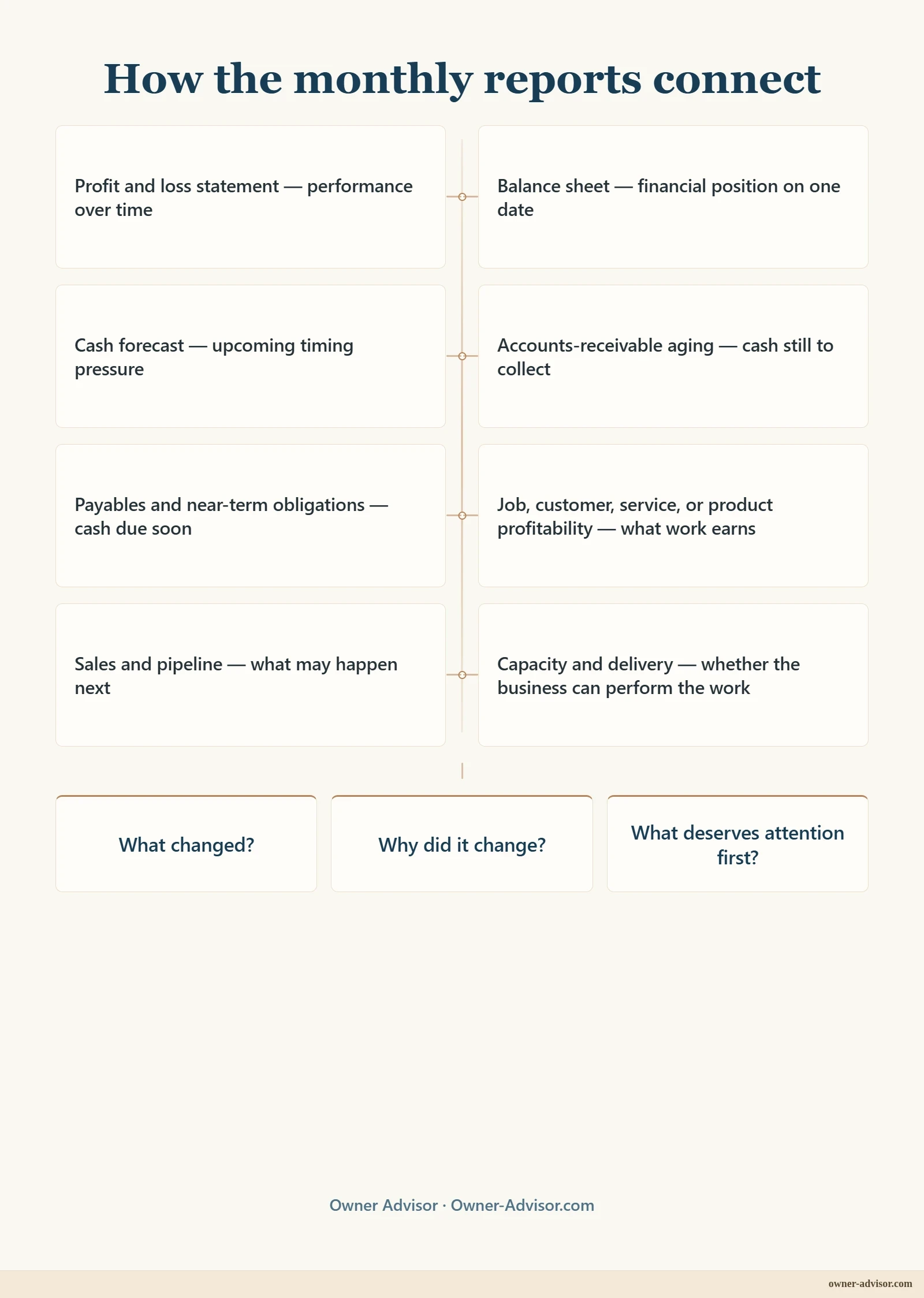
At minimum, review:
- 1. Profit and loss statement
- 2. Balance sheet
- 3. Cash forecast
- 4. Accounts-receivable aging
- 5. Accounts payable and near-term obligations
- 6. Job, customer, service, or product profitability
- 7. Sales or pipeline report
- 8. Capacity and delivery measures
This guide is the monthly review hub. It does not replace the deeper guides on reading a P&L, using a balance sheet, understanding cash pressure, reviewing profitability, following up on leads, or deciding whether the business can afford more capacity. Its purpose is to show how the reports work together. One report may show the symptom. Another may explain the cause. A third may show what is likely to happen next.
What does the profit and loss statement tell you?
The profit and loss statement, or P&L, shows performance over a month, quarter, or year.
Review:
- revenue;
- direct costs;
- gross profit;
- overhead;
- operating profit.
Use it to ask
- Did sales improve?
- Did gross margin strengthen or weaken?
- Is overhead growing faster than gross profit?
- Did operating profit improve?
- Was the change caused by price, volume, cost, or sales mix?
A contractor may show rising revenue while labor overruns weaken gross margin. A professional-service firm may grow sales while absorbing more scope creep. A retailer may increase revenue through discounts that reduce profit. For a deeper explanation, see How Do I Read and Use a Profit and Loss Statement for My Small Business?
What does the balance sheet tell you?
The balance sheet shows where the business stands on one date.
Review:
- cash;
- receivables;
- inventory or unfinished work;
- accounts payable;
- credit cards and debt;
- payroll and tax liabilities;
- working capital;
- current ratio.
The P&L may show a profit while the balance sheet shows that cash is tied up in receivables, inventory, equipment, or debt payments.
Working capital is current assets minus current liabilities.
The current ratio is current assets divided by current liabilities.
For example, if current assets are $120,000 and current liabilities are $100,000, the current ratio is 1.2.
A ratio below 1.0 can warn that near-term obligations exceed current assets. The right level depends on payment timing, inventory, seasonality, and business model. Use the ratio as a warning signal rather than a final judgment.
For a deeper explanation, see How Do I Read and Use a Balance Sheet for My Small Business?
Why should you review a cash forecast?
A cash forecast estimates when money is expected to enter and leave the business.
A rolling 13-week forecast is one practical planning horizon for upcoming payroll, taxes, supplier bills, debt payments, and customer collections.
The forecast does not need to predict every dollar perfectly. Its job is to show when timing may become tight.
A contractor may have profitable work scheduled but still face a shortage because materials and payroll are due before the next progress billing. A retailer may purchase seasonal inventory weeks before the related sales arrive.
Use the forecast to ask:
- When could cash become tight?
- Which customer payments are uncertain?
- Which obligations cannot be delayed?
- Does a hiring, equipment, or marketing decision use cash before producing a return?
For a deeper explanation, see Why Is Cash Flow Tight Even When Business Is Good?
What does the accounts-receivable aging report tell you?
The accounts-receivable aging report groups unpaid invoices by how long they have been outstanding.
Review:
- total receivables;
- amounts over 30, 60, and 90 days;
- disputed invoices;
- retainage;
- large customer balances;
- invoices that have not been sent promptly.
A $60,000 receivable balance is not automatically good or bad. If most invoices are recent and collectible, the balance may become cash soon. If half is more than 90 days old, the business may already have funded labor and materials without receiving the customer's cash. If receivables rise faster than sales, investigate billing and collections before assuming the business needs more customers. For the connection between collections and cash pressure, see Why Is Cash Flow Tight Even When Business Is Good?
What should you review on the payable side?
Review accounts payable together with every significant obligation due during the next 30 to 90 days.
That includes:
- supplier bills;
- credit cards;
- payroll;
- payroll and sales taxes;
- rent;
- insurance;
- loan payments;
- major subscriptions;
- planned inventory or equipment purchases.
An accounts-payable report may not show every upcoming cash requirement. If bills are being delayed, determine whether the cause is slow collections, insufficient gross margin, excessive overhead, unexpected spending, or recurring operating losses. Review payables with the balance sheet and cash forecast, not as a stand-alone vendor list.
Why review profitability below the company level?
A profitable company can contain unprofitable jobs, customers, services, or products.
Review profitability where the business actually earns money.
For a contractor, compare estimated and actual labor, materials, subcontractors, change orders, and gross profit by job.
For a professional-service firm, compare fees with delivery time, scope changes, and staff use.
For a retailer or product business, review margin by product category, channel, or customer group.
This helps answer which work the business should pursue, reprice, improve, or stop doing.
The company-wide P&L can hide weak work being subsidized by stronger work. For deeper diagnosis, see Why Is My Business Busy but Not Profitable?
Why review sales and pipeline?
Financial reports mostly explain what already happened. Sales and pipeline reports help show what may happen next.
Review:
- leads;
- quotes or proposals;
- follow-up status;
- close rate;
- expected revenue;
- backlog;
- cancellations;
- customer concentration.
A weak pipeline may become a revenue problem next month. A busy pipeline may still produce weak sales if leads are poorly qualified, quotes are slow, follow-up is inconsistent, or customers do not understand the value. For deeper diagnosis, see Why Am I Getting Leads but Not Sales?
Why review capacity and delivery?
A growing pipeline only helps if the business can perform the work well and on time.
Review:
- available labor or production hours;
- backlog;
- scheduled start dates;
- delivery delays;
- overtime;
- subcontractor dependence;
- rework;
- missed deadlines;
- owner workload.
A strong pipeline can create a capacity and cash problem if the business lacks the labor, materials, management time, or working capital to deliver. If more work would require hiring, equipment, or another fixed cost, review whether the business can support that added capacity before committing. See Can I Afford to Hire Someone for My Small Business?
How should you use the reports together?
The strongest monthly review looks for connections.
If revenue is rising but cash is falling
Review receivables, inventory, equipment purchases, loan principal, customer deposits, and owner withdrawals.
If sales are strong but gross margin is weakening
Review pricing, estimating, direct costs, scope control, rework, discounts, and sales mix.
If profit is stable but debt keeps increasing
Review cash timing, capital purchases, owner withdrawals, and whether borrowing is covering ordinary operations.
If the pipeline is growing but delivery is slowing
Review staffing, scheduling, job progress, rework, and available capacity before accepting more work.
If receivables look healthy but payables are aging
Review whether receivables are collectible, whether invoices were actually sent, where cash has been used, and what obligations were missing from the forecast.

What should the monthly review produce?
End with a short action record:
- What changed?
- What is the most likely reason?
- What information is missing?
- What deserves attention first?
- What action will be taken?
- Who owns it?
- When will it be reviewed again?
Choose one to three actions. A review that creates fifteen priorities usually creates no real priorities.
What kind of help do you need next?
If the reports appear accurate but the connections among profit, cash, debt, sales, workload, and hiring are unclear, Owner Advisor is being built to help owners keep those decisions connected over time.
If the records are incomplete, accounts do not reconcile, or lender-ready, tax, or formal financial reporting is required, ask a qualified bookkeeper or CPA to help prepare or review the reports.
Key takeaways
- No single report explains the whole business.
- The P&L shows performance; the balance sheet shows financial position.
- The cash forecast shows what may happen next.
- Receivable, payable, profitability, sales, and capacity reports explain why the numbers are moving.
- Use the reports together to identify connected problems.
- End each monthly review with one to three specific actions.
- The value of a monthly review is not the number of reports produced. It is whether the owner catches the right problem early enough to act.
Related Business Guides
- How do I read and use a profit and loss statement for my small business?
- How do I read and use a balance sheet for my small business?
- Why is cash flow tight even when business is good?
- Why is my business busy but not profitable?
- Why am I getting leads but not sales?
- Can I afford to hire someone for my small business?
Owner Advisor Business Guides are educational and practical. They do not replace legal, tax, accounting, HR, insurance, lending, or regulatory advice. Learn more about how we create and review our guides.
Browse Free Business Guides or read the Business Owner FAQ for what is available today.