

Profit looks okay, but cash does not
See why profit and the bank balance can move differently instead of assuming one of the numbers must be wrong.
Free Monthly Financial Review Workbook
A profitable month does not always mean more cash in the bank.
This workbook helps you understand what changed, why the numbers may be telling different stories, and what deserves your attention next.
Free Excel workbook. No account required. Anything you download is yours to keep.
Created by Josh Keller, CFO and business owner, for owner-led businesses.
Here is a fictional example of the kind of question the workbook helps you work through.
Sales increased, but much of the additional money was still waiting to be collected. At the same time, profit slipped and the business had other cash demands during the month.
The result: a stronger sales month did not become a stronger cash month.
The workbook helps you keep following the numbers until you understand what changed instead of stopping at "sales were up."
Fictional illustrative example.
When this helps
You do not need more reports for the sake of having them. You need to know what the reports mean for the business.
See why profit and the bank balance can move differently instead of assuming one of the numbers must be wrong.
Find out whether margins, expenses, customer payment timing, inventory, or other demands are using up the benefit of additional revenue.
Use a repeatable review to identify what changed, what needs an explanation, and what should happen next.
What you get
Instead of reviewing each statement separately, use the workbook to connect the month and narrow down what deserves another look.
See what's inside
Each part of the workbook has a different job.
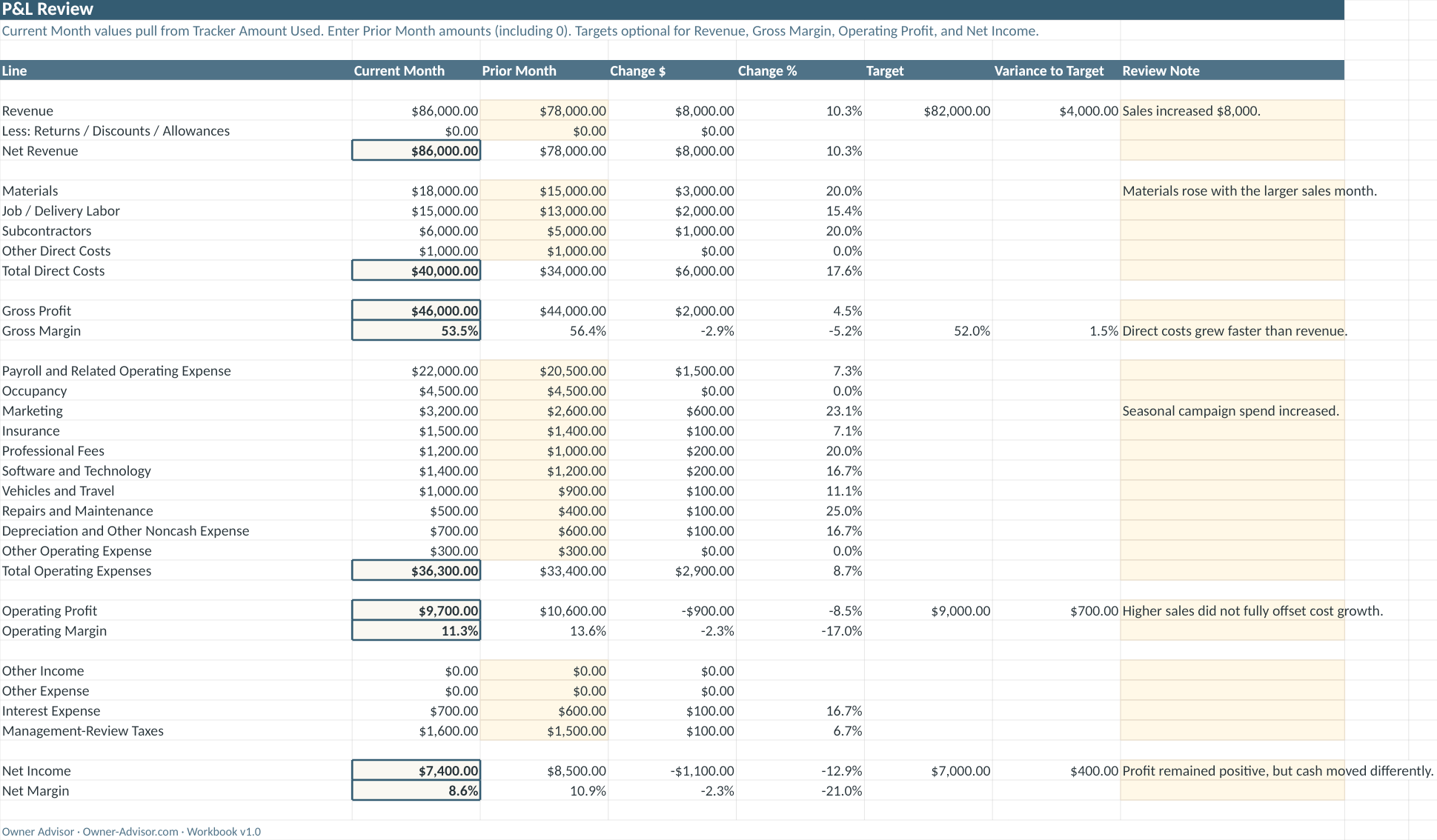
Understand how the month performed.
Compare revenue, direct costs, gross profit, operating expenses, and operating profit with the prior period and the targets you use. The goal is to see where performance changed, not simply whether revenue went up.
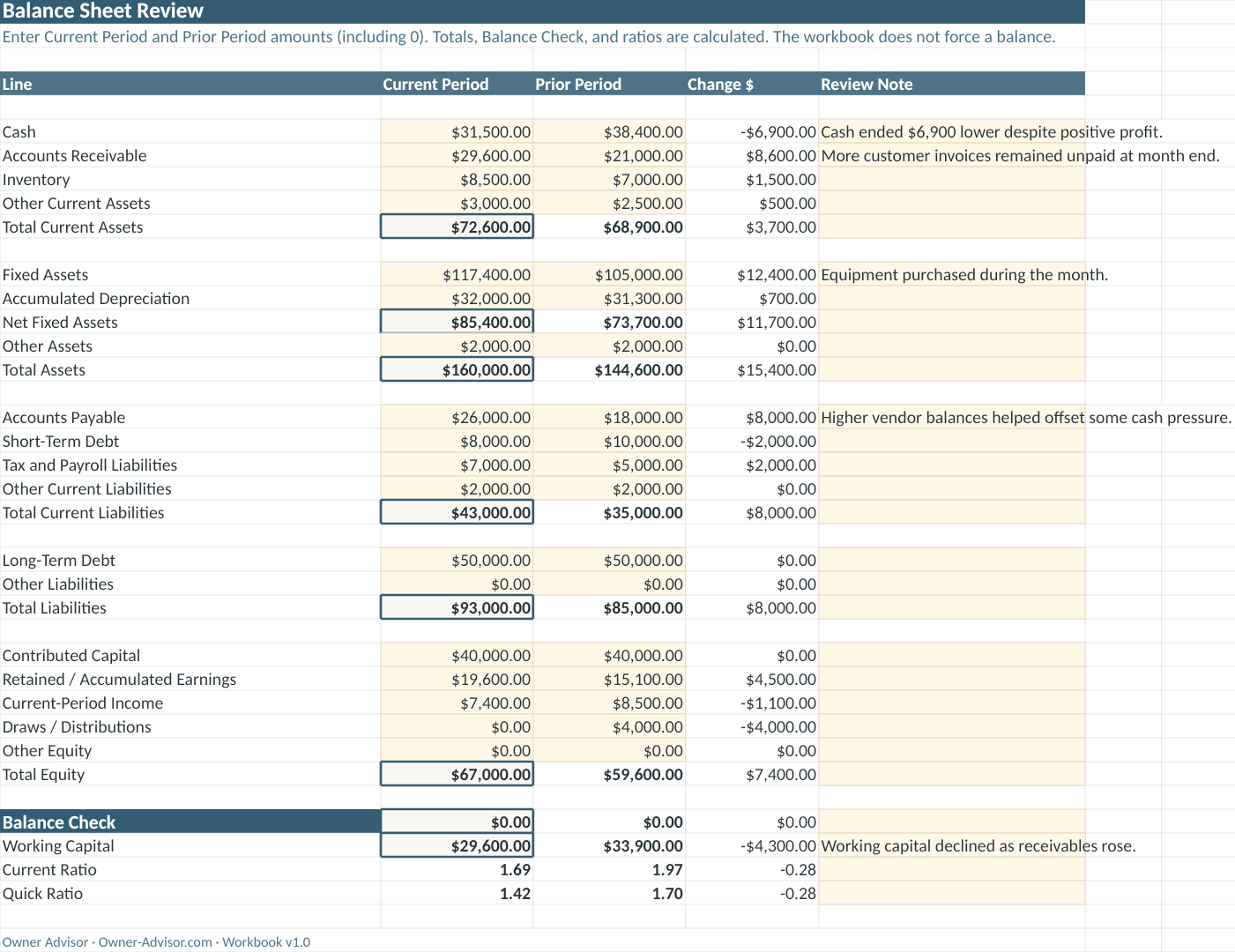
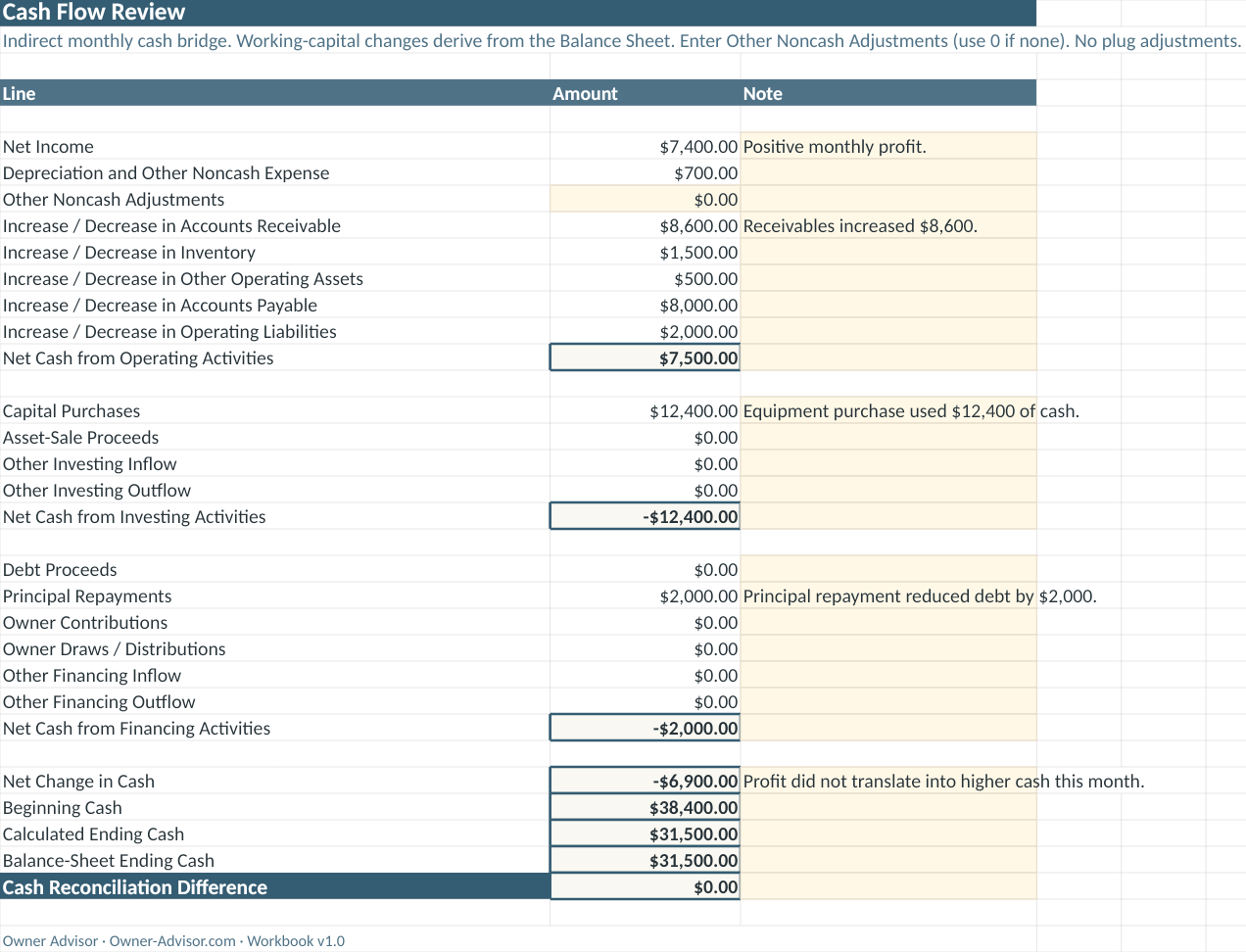
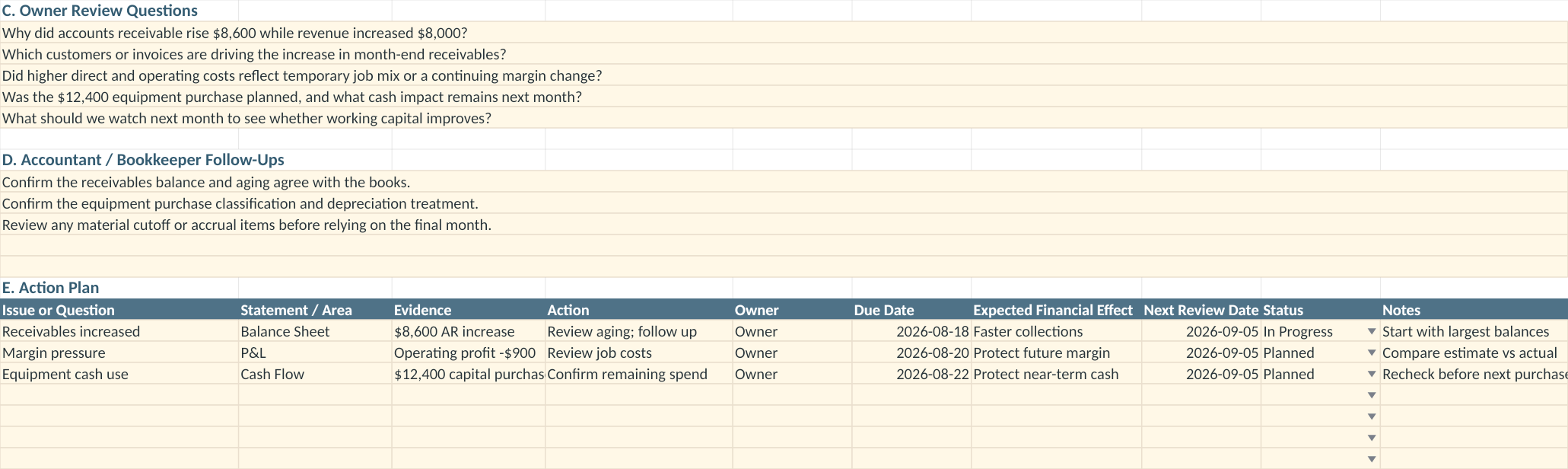
Worksheet overview
Statement ConnectionsFinancial information is less useful when important pieces do not agree or something is missing. The workbook checks key relationships and tells you when: - the numbers appear to tie; - something needs to be checked; - a question requires human judgment; or - the information is not complete enough to finish the review. Reconciled: the relationship appears to tie. Review difference: something does not fully agree and should be checked. Review manually: the issue needs human judgment. Incomplete: there is not enough information to finish the review.
All names, amounts, dates, businesses, and scenarios shown in the previews are illustrative.
Start with one completed month
Start with the financial information you already have.
A useful monthly review is less about completing every box and more about knowing what deserves attention.
Use the financial information you already have.
Start with one completed month and the reports or records you normally rely on.
Follow the changes that matter.
Work through performance, financial position, and cash until you understand where the important differences are coming from.
Decide what happens next.
Finish with the action plan: what needs explanation, who owns the follow-up, and what should be checked again next month.
Workbook details
Related resources
Use the current page to connect the month. These guides and tools help with the closest questions that may come out of the review.
Understand which reports are useful to review regularly and what each one can tell you.
Understand what revenue, costs, margins, and profit are telling you.
Understand what the business owns, owes, and has invested in it at a point in time.
Work through common reasons a profitable or growing business can still feel short on cash.
Build a forward-looking view of upcoming cash needs and timing.
Common questions
It helps you connect monthly performance, financial position, and cash movement so you can see what changed, what may need explanation, and what deserves attention next. It is designed for management review, not for producing official accounting statements.
No. The workbook supports summarized category information or a more detailed transaction feed. Use one consistent source so the same activity is not counted twice.
Because profit does not explain everything happening in the business. Receivables, inventory, payables, debt, equipment purchases, owner activity, and other changes can materially affect cash and the financial position of the business even when the P&L looks healthy.
That is useful information. The workbook is designed to surface missing information and reconciliation differences rather than hide them. That gives you something specific to investigate before relying on the numbers.
No. The Monthly Financial Review Workbook helps you understand what happened during a completed month. The 13-Week Cash-Flow Workbook helps you look forward at near-term cash timing.
No. It does not replace your bookkeeping system, bank reconciliation, bookkeeper, or accounting software.
No. It is a management-review tool. It is not a GAAP statement generator, audit, attest service, or certified financial-statement preparation tool.
No. It is a management view designed to help you understand how different types of business activity affected cash during the month.
One unusual month may just need an explanation.
But if receivables keep climbing without anyone asking why, a manageable timing issue can become a much harder cash problem.
A simple monthly review gives you a chance to notice the change while there is still time to understand it and respond.
Educational monthly review aid; not bookkeeping, CPA, tax, audit, or lending advice; distinct from the T-006 forecast.
Enter your email and we'll send you the workbook. No account required. Anything you download is yours to keep.