

Free Business Guides
How Do I Read and Use a Profit and Loss Statement for My Small Business?
Start with revenue, direct costs, overhead, and operating profit, then ask what changed, why it changed, and what deserves attention next.
How should a small-business owner read and use a profit and loss statement?
Start with four parts of the report:
- 1. Revenue
- 2. Direct costs
- 3. Overhead
- 4. Operating profit
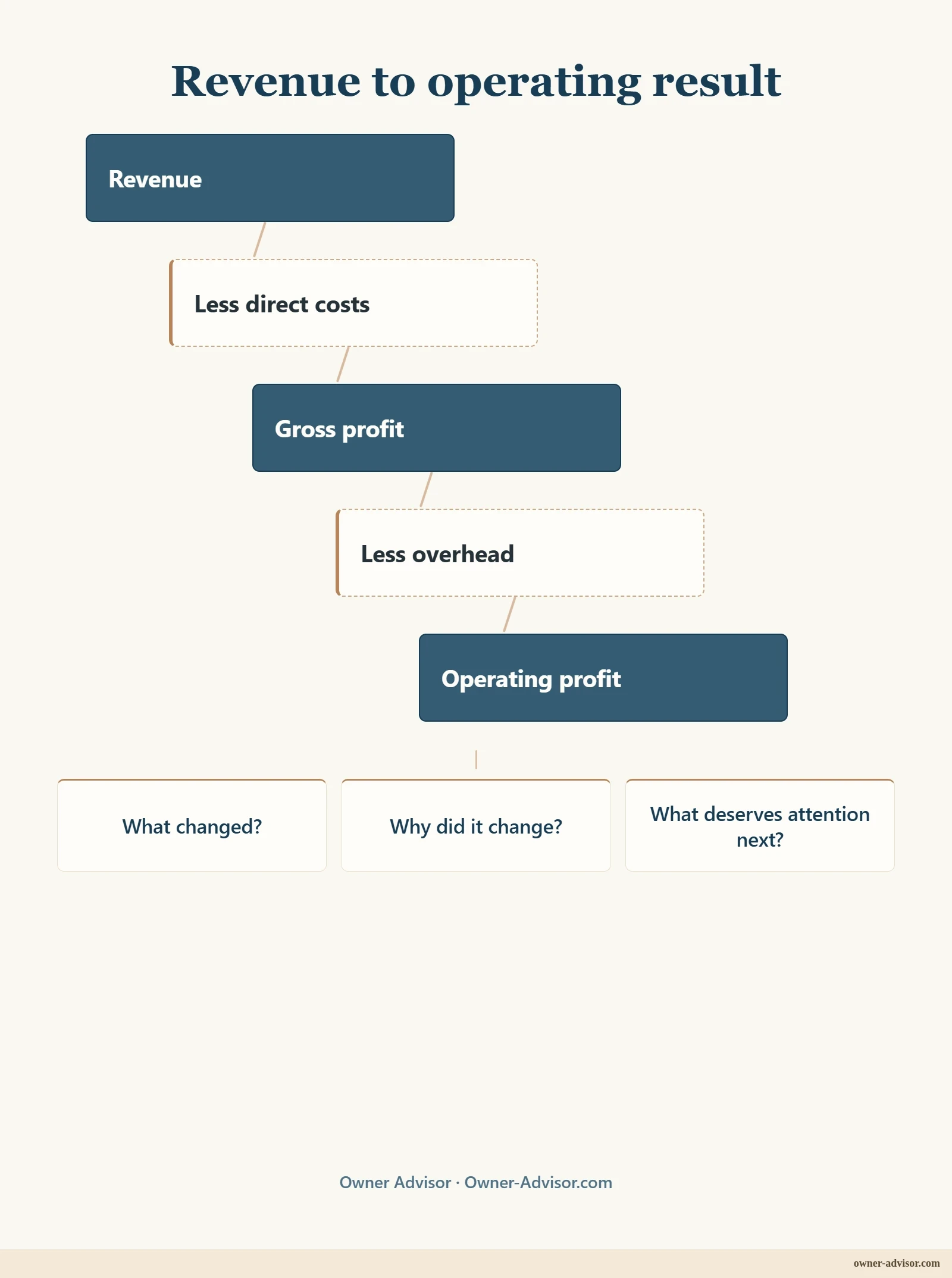
Then ask what changed, why it changed, and what deserves attention next.
The basic flow is revenue minus direct costs equals gross profit, and gross profit minus overhead equals operating profit.
A profit and loss statement, often called a P&L or income statement, shows how the business performed over a month, quarter, or year.
Reading it means understanding the numbers. Using it means deciding what to investigate before a pricing, margin, overhead, or cash problem becomes more expensive.
What does revenue tell you?
Revenue is the amount the business earned from sales during the period, based on the accounting method being used.
Compare it with:
- the prior month;
- the same period last year;
- the budget or sales target;
- the amount and type of work completed.
Revenue growth is usually welcome, but it does not automatically mean the business improved. A contractor may increase sales by accepting more low-margin jobs. A service business may grow by adding overtime or subcontractors. A retailer may increase revenue through discounts that weaken profit. Ask what caused the change. Did prices rise? Did the business complete more work? Did the customer or service mix change? Was there one large sale that may not repeat? Use revenue to understand activity, not to judge profitability by itself.
What are direct costs?
Direct costs are the costs closely tied to producing a product or delivering a service.
Depending on the business, they may include materials, job labor, subcontractors, shipping, commissions, merchant fees, or production supplies.
Revenue minus direct costs equals gross profit.
For example:
- Revenue: $100,000
- Direct costs: $60,000
- Gross profit: $40,000
Gross margin is calculated as gross profit divided by revenue.
In this example, $40,000 / $100,000 = 40% gross margin.
That means 40 cents of every sales dollar remains to cover overhead and produce operating profit.
If gross margin falls, the reason may depend on how the business works.
A contractor may have missed labor hours, material overruns, weak change-order control, or underpriced jobs. A professional-service firm may be absorbing scope creep or spending more delivery time than expected. A retailer may be dealing with supplier increases, shipping costs, markdowns, or a weaker product mix.
Use gross margin to decide whether pricing, estimating, purchasing, delivery, or sales mix needs attention.
What is overhead?
Overhead is the cost of keeping the business operating that is not directly assigned to one specific job, product, or customer.
A P&L may label this section operating expenses, but most owners understand it more easily as overhead.
Common overhead costs include office payroll, rent, software, insurance, bookkeeping, professional fees, advertising, phones, management salaries, and vehicles or equipment not assigned directly to jobs.
Many owners understand selling price and direct job cost but do not understand how much overhead every sales dollar must support.
Overhead should be reviewed in dollars and as a percentage of revenue: overhead divided by revenue equals the overhead percentage.
Suppose the business has:
- Revenue: $100,000
- Direct costs: $60,000
- Gross profit: $40,000
- Overhead: $32,000
- Operating profit: $8,000
The percentages are a 40% gross margin, overhead equal to 32% of revenue, and operating profit equal to 8% of revenue.
The gross margin may look healthy, but most of it is needed to carry overhead. Gross profit is not the final profit.
How should you use the overhead percentage?
Use it to see whether the business is carrying more overhead than its current sales and gross profit can support.
Suppose overhead remains $30,000 per month:
- At $100,000 of revenue, overhead equals 30% of sales.
- At $75,000 of revenue, the same overhead equals 40% of sales.
The business did not spend more, but overhead became heavier because revenue fell. Some overhead is fixed in the short term. Other overhead rises in steps when the business adds an employee, vehicle, location, or software package before the additional sales arrive. Before adding overhead, ask how much additional gross profit this expense must help create. That is more useful than asking only whether the monthly payment fits in the bank account today.
What does operating profit tell you?
Operating profit is what remains after direct costs and overhead are subtracted from revenue.
It shows whether the core business generated enough gross profit to support the cost of running the company.
A business can have strong revenue and a reasonable gross margin but still earn little operating profit because overhead is too high. It can also have modest revenue and strong operating profit because pricing, direct costs, and overhead are controlled well.
Do not stop at the final number. Ask what caused it.

Why is P&L profit different from cash?
Reported profit is not the same as available cash.
The two can differ because revenue may be recorded before a customer pays, inventory purchases use cash before the inventory is sold, loan principal uses cash without becoming a P&L expense, equipment may use cash immediately but appear gradually through depreciation, and owner draws generally use cash without reducing operating profit.
A contractor may report profit while waiting on progress payments or retainage. A retailer may have profit tied up in inventory. A service business may have completed work that has not yet been collected.
Use the P&L to understand operating performance. Use the balance sheet, receivable aging, payables, bank activity, and a cash forecast to understand where the cash went.
What are the most common P&L mistakes?
Mistaking revenue growth for better performance
Revenue can rise while gross margin or operating profit falls. More work is not automatically better work.
Confusing gross profit, operating profit, and cash
Gross profit still has to cover overhead. Operating profit does not equal cash in the bank. Each number answers a different question.
Trusting the report without checking the detail
Misclassified labor, materials, owner transactions, debt activity, or unusual expenses can distort the result. A report can be mathematically correct and still tell the wrong operating story.
How should you use the P&L to decide what to do next?
Use the pattern in the report to choose one next investigation.
If revenue is rising but gross margin is falling
Review pricing, direct costs, estimates, scope control, discounts, rework, and sales mix.
If gross margin is stable but operating profit is falling
Review overhead. Identify what increased, whether the change is temporary or permanent, and how much gross profit the expense must help create.
If operating profit looks healthy but cash is tight
Review receivables, inventory, debt principal, equipment purchases, owner draws, deposits, and upcoming obligations.
If one month looks unusually strong or weak
Separate recurring performance from one-time jobs, expenses, timing differences, and seasonal effects.
If the numbers do not match what you see in the business
Check the classifications and underlying transactions before making a major decision.
The goal is not to react to every line. It is to find the one or two changes that best explain what is happening.
What should you do after reviewing the P&L?
Write down:
- what changed;
- the most likely reason;
- what information is still missing;
- the next action;
- when you will review it again.
Then choose the right next step. Owner Advisor is being built to help owners connect those decisions over time as pricing, costs, cash, workload, and priorities change. If the books do not reconcile, classifications appear inaccurate, or a tax, lending, or formal accounting decision depends on the report, ask a qualified bookkeeper, accountant, or CPA to review it.
Key takeaways
- Revenue minus direct costs equals gross profit.
- Gross profit minus overhead equals operating profit.
- Overhead should be reviewed as a percentage of revenue.
- A healthy gross margin can still produce weak operating profit.
- Revenue growth does not automatically mean better performance.
- Reported profit is not the same as available cash.
- Use the pattern in the P&L to decide what to investigate next.
Related Business Guides
Owner Advisor Business Guides are educational and practical. They do not replace legal, tax, accounting, HR, insurance, lending, or regulatory advice. Learn more about how we create and review our guides.
Browse Free Business Guides or read the Business Owner FAQ for what is available today.