

Free Business Guides
Why Is My Business Busy but Not Profitable?
A business can be busy and still fail to keep enough money.
Busy is visible. Profit is quieter.
The problem is often not the amount of work coming in. It is what that work leaves behind after direct costs, full labor and owner time, rework, overhead, owner pay, and payment timing.
That is why more sales are not always the right first move.
If the current work is underpriced, difficult to deliver, slow to collect, or too demanding, adding more of the same work can make the business feel even more stretched.
The phone rings. The calendar fills. Orders move. Crews work. Customers keep asking for things.
Those are visible signs of activity.
Profit depends on less visible questions:
- Was the work priced correctly?
- Did it take more time than expected?
- Was the owner's time counted?
- Did rework erase part of the result?
- Did the job contribute enough toward overhead?
- Was the money collected on time?
- Would the business want more work like it?
A full schedule can therefore hide weak economics. The business may look successful from the outside while the owner feels like the money never stays.

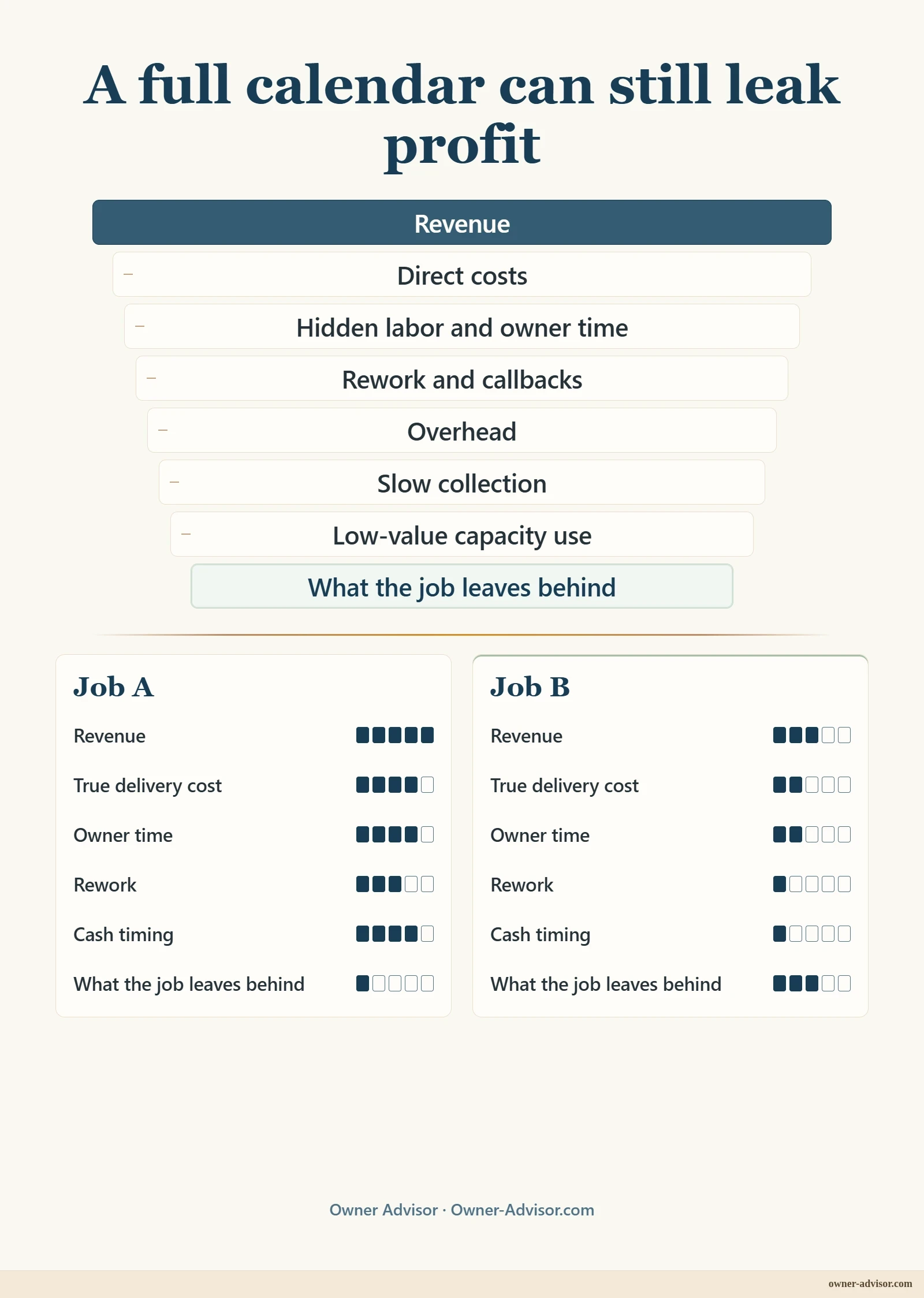
Use this guide to find the leak
This guide owns the broad diagnostic: which part of the work is preventing the business from keeping enough money?
It does not replace deeper analysis.
- How to Price Service Jobs Without Guessing explains how to rebuild the economics of one service or quote.
- Why Is Cash Flow Tight Even When Business Is Good? goes deeper when the main issue is when money enters and leaves the business.
Here, the goal is to locate the first problem worth investigating.
Compare what the jobs actually leave
Consider two service jobs.
Job A: $4,800 of revenue
- Materials and subcontractors: $1,600
- Loaded crew labor: $1,400
- Owner estimating and coordination time: $600
- Callback and rework: $350
- Overhead share: $500
Amount left: $4,800 - $1,600 - $1,400 - $600 - $350 - $500 = $350 That is about 7.3% of revenue. The customer also paid 45 days after completion, so the business carried the costs for more than a month.
Job B: $3,600 of revenue
- Materials: $900
- Loaded crew labor: $900
- Owner time: $180
- Rework: $0
- Overhead share: $400
Amount left: $3,600 - $900 - $900 - $180 - $400 = $1,220 That is about 33.9% of revenue.
Job A produced more sales and made the business look busier. Job B was smaller but left much more economic room. The point is not that smaller jobs are always better. The point is that owners need to compare what the work leaves, not only what it brings in.
Put a reasonable value on owner time
The review will be misleading if the owner's selling, estimating, coordination, and problem-solving time is treated as free.
Use one of these methods.
Method 1: Replacement-cost method
Estimate what the business would have to pay another capable person to perform the same work, including payroll burden or contractor cost.
If replacing the owner's estimating and project-management work would cost about $60 per hour, use $60 as the starting value.
Method 2: Required-owner-pay method
Decide the annual compensation the business needs to provide for the owner's working role, separate from profit.
Then divide by realistic working hours.
For example:
- Required annual owner compensation: $90,000
- Realistic productive and management hours: 1,800
Owner-time value: $90,000 / 1,800 = $50 per hour
Use one consistent method across the jobs being compared. This is a management estimate, not necessarily the amount that will appear as an hourly expense in the accounting records. The purpose is to stop the business from calling work profitable only because the owner supplied unpaid labor.
Find the likely profit leak
1. Pricing or scope is too tight
Evidence to look for:
- Actual labor or materials repeatedly exceed the estimate.
- Jobs leave little room unless everything goes perfectly.
- Customers regularly receive work that was not clearly included.
- Similar jobs show the same shortfall.
What it usually means: The price may be too low, the scope may be too loose, or the estimating assumptions may be outdated. Rebuild one representative job using actual cost and time. Do not begin with a blanket increase until you know where the economics changed.
2. The wrong work is filling the schedule
Evidence to look for:
- Certain job types create more calls, travel, delays, or owner involvement.
- High-revenue work leaves less contribution than smaller work.
- Better opportunities are delayed or declined because the calendar is full.
- Some customers consistently resist normal pricing or payment terms.
What it usually means: The business may have a work-mix or customer-fit problem rather than a sales-volume problem. The decision may involve minimum charges, service boundaries, customer selection, packages, scheduling, or changing which work the marketing emphasizes.
3. Hidden time is not being counted
Evidence to look for:
- Actual hours exceed quoted or scheduled hours.
- The owner finishes estimating, ordering, invoicing, or problem-solving after normal work hours.
- Small jobs require nearly as much administration as large ones.
- Travel, setup, cleanup, and customer communication are missing from estimates.
What it usually means: The job cost includes only the visible delivery time. Track the complete process for a small sample of jobs. Then decide whether to raise the price, simplify the process, set a minimum charge, or stop accepting work with too much surrounding effort.
4. Rework and callbacks are erasing the result
Evidence to look for:
- The same job type, crew, material, or scope issue appears repeatedly.
- Completed work consumes additional labor before another invoice can be issued.
- Collections are delayed by unresolved problems.
- Warranty and complaint time is higher than expected.
What it usually means: The business is paying to perform part of the work twice. Identify the repeat cause before increasing volume. The correction may belong in training, scope, materials, quality control, handoffs, supervision, or pricing for unavoidable risk.
5. Overhead has outgrown the work's contribution
Evidence to look for:
- Monthly overhead has risen faster than contribution from completed work.
- The contribution needed to cover overhead is higher than the amount the current job mix produces.
- Revenue increased, but the break-even sales level increased just as fast or faster.
- Vehicles, rent, insurance, software, administration, equipment, or management costs rose without a matching pricing or productivity improvement.
What it usually means: The company is producing too little contribution for its current cost structure. Compare monthly overhead with total contribution from the same period: Contribution available for overhead = earned revenue from completed work - direct delivery costs Use earned revenue consistently for this profitability test, whether the business tracks it when work is completed or invoiced. Then review collected cash separately to understand timing and liquidity. Ask whether the contribution consistently covers overhead, reasonable owner pay, and the profit target the business set for itself. The relevant question is not whether sales increased. It is whether contribution increased enough to support the expanded business.
6. Collection timing is creating pressure
Evidence to look for:
- Jobs appear profitable but payroll and suppliers are due before customer payment.
- Invoices are issued late.
- Deposits are too small for the cash required to begin.
- Receivables are growing faster than collected sales.
- Disputes or incomplete paperwork delay payment.
What it usually means: The economics and the cash cycle may be telling different stories. Improve deposits, billing speed, progress payments, terms, and follow-up. But do not confuse faster collection with better profit. An underpriced job remains underpriced even when it is paid promptly.
Review the last 10 jobs or customers
Do not begin with total monthly sales. Averages can hide the pattern.
For each of the last 10 jobs, orders, customers, or service visits, record:
- revenue earned and cash collected;
- direct materials, subcontractors, and loaded employee labor;
- estimated hours versus actual hours;
- owner selling, estimating, coordination, and problem-solving hours;
- owner-time value using one consistent hourly method;
- discounts, extras, rework, returns, callbacks, or warranty cost;
- a reasonable overhead contribution;
- days from starting the work to collecting cash;
- schedule disruption;
- the most likely leak category: pricing or scope, work mix, hidden time, rework, overhead, or collection timing.
Then sort the work into three groups.
More
Put work here when it:
- leaves acceptable contribution after full cost;
- pays within normal terms;
- uses a reasonable amount of owner and team time;
- fits the business's capacity and service model;
- has no repeated leak that would make more volume dangerous.
Fix
Put work here when the underlying opportunity is worthwhile but a specific, correctable problem weakens the result.
Examples include:
- outdated pricing;
- loose scope;
- hidden administrative time;
- avoidable rework;
- weak deposits or billing;
- a process that can reasonably be improved.
Stop
Put work here when it repeatedly:
- leaves inadequate contribution;
- requires excessive owner rescue;
- creates recurring rework or collection problems;
- disrupts better work;
- cannot be corrected without changing the customer, service, price, or business model substantially.
There is no universal margin cutoff for every business. Use the business's own required contribution, cash needs, capacity, and risk. The purpose of the sort is not to produce a perfect score. It is to distinguish healthy work from correctable work and work the business should stop repeating.
Do not assume the answer is more sales
More sales help only when the next sale is worth doing.
If the business has a margin leak, more work can enlarge it. If capacity is already constrained, added volume can increase overtime, delays, rework, and owner dependence.
Start with the leak closest to the money and supported by evidence.
- Rebuild pricing when actual costs or hours no longer match the estimate.
- Change the work mix when weak jobs fill the schedule.
- Count owner and hidden time.
- Correct recurring rework before selling more of the same work.
- Tighten billing and collections without pretending timing will repair weak economics.
A Margin Leak Checklist remains planned. The Pricing and Job-Profitability Workbook is available through Owner Advisor's Free Business Tools. The 10-job review above remains usable on its own. The goal is not simply a busier business. It is a business that keeps enough of what it earns without requiring the owner to rescue every job personally. Once you know where the money is being lost, the next step is keeping that issue visible long enough to fix it.
Get the Pricing and Job-Profitability Workbook
Use the workbook to inspect margin leaks across jobs.
Related Business Guides
Get the Monthly Owner Guide
Get practical questions and decision tools for working through pricing, profit, workload, cash, and what deserves attention next—without adding more activity before the real problem is clear.
Owner Advisor Business Guides are educational and practical. They do not replace legal, tax, accounting, HR, insurance, lending, or regulatory advice. Learn more about how we create and review our guides.
Browse Free Business Guides or read the Business Owner FAQ for what is available today.