

Free Business Guides
Should I Raise Prices Because My Costs Went Up?
Raise prices when higher costs are materially reducing the margin, cash support, delivery quality, or capacity of work that is otherwise worth keeping.
First identify
Do not raise every price simply because the business feels more expensive to run.
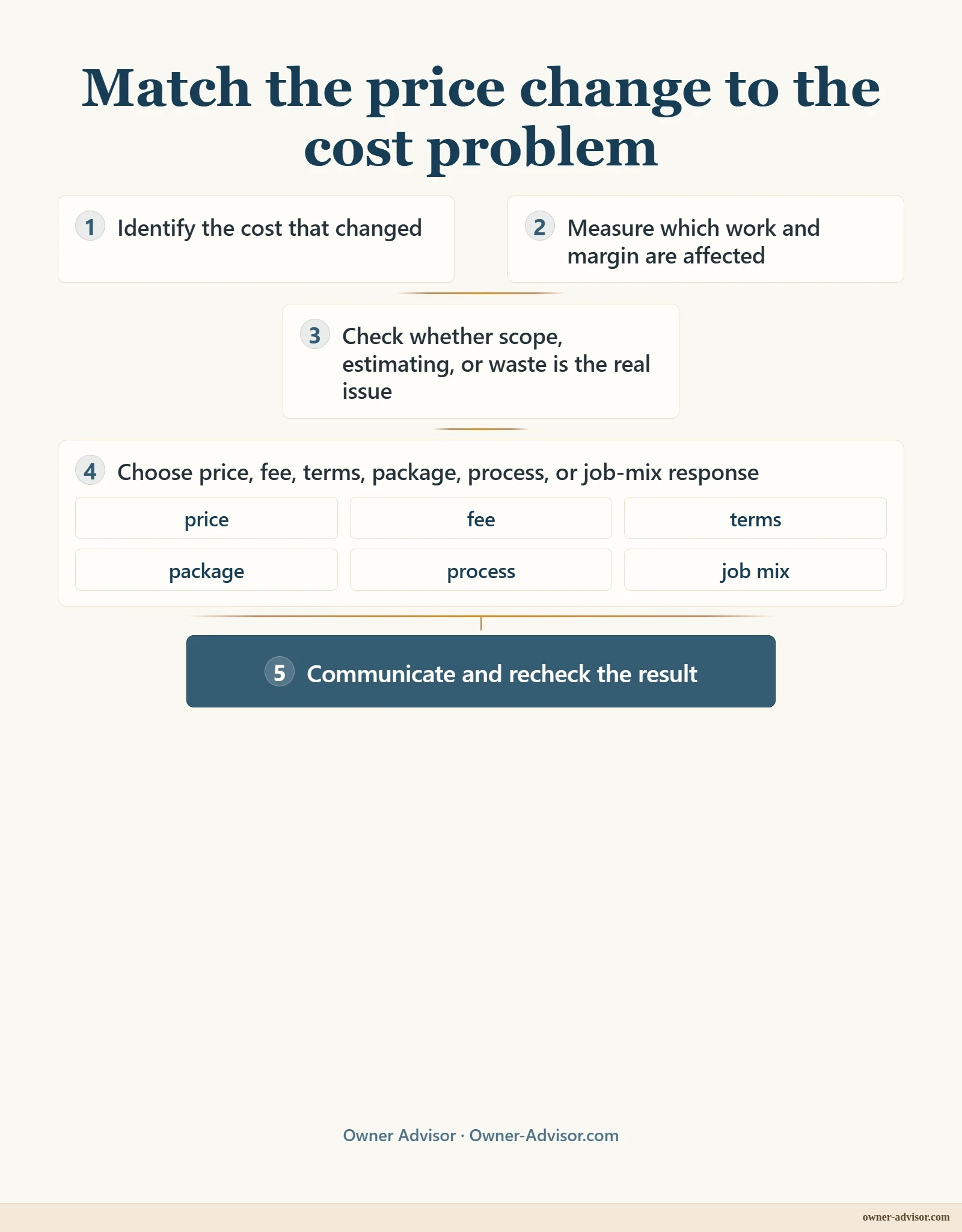
First identify:
- which cost changed;
- which work is affected;
- how much margin was lost;
- whether price is actually the right fix.
A price increase should match the problem it is meant to repair.
Why a blanket increase can miss the problem
Costs rarely rise evenly across the business.
One material may affect only a few services. Fuel may hurt distant jobs. Insurance and rent may raise overhead across the company. Labor overruns may come from weak estimates rather than higher wage rates. Rework may be the real cost increase even when supplier prices stayed stable.
That means one percentage applied everywhere can be too blunt.
It may:
- make healthy work less competitive;
- leave the weakest work underpriced;
- upset good recurring customers unnecessarily;
- hide scope, estimating, or process problems;
- preserve poor work instead of replacing it.
Sometimes the right response is a price increase. Sometimes it is a trip fee, larger minimum, deposit, updated package, clearer scope, supplier change, process correction, or decision to stop offering the work.
Measure what the cost increase did to margin
Suppose a common service job sells for $2,500.
Before the increase:
- Direct materials and loaded labor: $1,650
- Overhead allocation: $350
Old cost base:
$1,650 + $350 = $2,000
Old margin dollars:
$2,500 - $2,000 = $500
Old margin percentage:
$500 / $2,500 = 20%
The overhead allocation is the portion of operating cost assigned to the job. It is part of the cost base.
The $500 of margin dollars is what remains after that cost base. The two numbers serve different purposes.
Now materials and labor increase by $250.
New cost base:
$2,000 + $250 = $2,250
If the price stays at $2,500:
$2,500 - $2,250 = $250 of margin dollars
New margin percentage:
$250 / $2,500 = 10%
The job still produces positive margin, but half of the original margin percentage has disappeared.

Decide what you are trying to restore
There are two different pricing goals.
Restore the same margin dollars
To leave the same $500:
$2,250 + $500 = $2,750 price
That restores the same dollar amount but not the same percentage margin.
Margin at $2,750:
$500 / $2,750 = about 18.2%
Restore the same margin percentage
To restore the original 20% margin:
Target price = $2,250 / 80%
Target price = $2,812.50
A practical quoted price might be $2,815 or $2,825, depending on your pricing convention.
For the rest of this example, assume you choose to restore the original percentage margin and set the new price at $2,815.
Restoring the same margin dollars and restoring the same margin percentage are different decisions.
Decide whether you are protecting:
- a dollar contribution;
- a target margin;
- available capacity;
- cash requirements;
- a strategic customer or service;
- some combination of those goals.
How to Price Service Jobs Without Guessing explains how to rebuild the full cost base and target price when more than one assumption has changed.
Find the cost that actually changed
Replace the feeling that "everything costs more" with evidence.
Review recent:
- supplier invoices;
- payroll and labor burden;
- subcontractor quotes;
- freight and fuel;
- insurance;
- rent;
- software;
- financing;
- rework and warranty costs;
- hours required to complete the work.
Then connect the increase to specific jobs, services, products, locations, customers, or order sizes.
For example:
- Higher travel cost may call for a tighter service area, trip fee, or minimum charge.
- One expensive material may affect only certain services.
- Higher overhead may require broader pricing changes.
- Labor overruns may require better estimating or scope control.
- Rework may require an operating fix before a price increase.
A broad inflation number is not your pricing calculation.
Check whether price is the real problem
Use these tests before changing the price.
Pricing problem
Likely when:
- current cost and time are accurate;
- scope is controlled;
- waste and rework are normal;
- the work is worth keeping;
- the existing price no longer leaves enough margin.
A targeted increase is usually appropriate.
Scope problem
Likely when:
- customers regularly receive work not clearly included;
- changes are accepted without additional price;
- exclusions and assumptions are vague;
- the same type of disagreement repeats.
The fix may be clearer packages, options, allowances, exclusions, or change-order rules.
Estimating problem
Likely when:
- actual hours regularly exceed quoted hours;
- material quantities are consistently low;
- travel, preparation, cleanup, or owner time are omitted;
- cost assumptions are outdated.
Update the estimate before applying a general percentage increase.
Process or waste problem
Likely when:
- rework, callbacks, poor scheduling, purchasing delays, or handoff errors repeat;
- the same work performs differently depending on crew or process;
- cost rises because the work is being delivered inefficiently.
A price increase may help temporarily, but it does not remove the leak.
Work-mix problem
Likely when:
- certain services consume too much owner or crew capacity;
- better work is delayed because weak work fills the schedule;
- customers resist normal pricing or payment terms;
- the work no longer fits the direction of the business.
The right answer may be a minimum, redesign, tighter boundaries, or stopping the service.
Choose the smallest response that repairs the problem
Change the price, fee, minimum, or payment structure
Use this when the work is worth keeping and the current economics no longer support it.
Possible responses include:
- targeted service increase;
- material allowance;
- trip fee;
- minimum charge;
- updated package;
- larger deposit;
- progress payment.
Use payment changes to solve timing. Do not use them to disguise weak total pricing.
Change the scope or service level
When a customer cannot support the full price, reduce or phase the promise rather than quietly removing margin.
Options may include:
- smaller scope;
- different materials;
- standard versus premium package;
- phased schedule;
- fewer extras;
- clearly defined exclusions.
Change the process, supplier, or work mix
When the cost problem comes from waste, rework, purchasing, scheduling, or poor fit, operating changes may protect more margin than price alone.
Some work may no longer belong in the business.
Explain the change clearly
Customers usually need to know:
- what is changing;
- when it changes;
- what remains included;
- what alternatives are available.
They do not need your full cost structure.
A simple explanation might be:
"Starting August 1, this service will be $2,815. Our labor and material costs for this work have changed, and the updated price lets us maintain the same scope, scheduling, and service standard. I can also show you a smaller-scope option if that fits the budget better."
Do not apologize for a supported decision.
Do not blame the customer or overstate the business's hardship.
For contracts, regulated pricing, public bids, franchise rules, or competition-law concerns, confirm the approach with the appropriate qualified professional.
What if customers push back?
Pushback is information, not an automatic reason to discount.
Ask what the customer is comparing.
If the issue is:
- budget: offer smaller or phased scope;
- comparison shopping: explain inclusions and exclusions;
- value: improve the proof and explanation;
- timing: consider schedule or payment options;
- poor fit: be willing to let the work go.
Suppose the new price is $2,815 and the customer asks to keep the old $2,500 price.
That $315 reduction would remove most of the restored margin.
Do not reduce the price without changing scope, materials, timing, risk, or service level.
Run one cost-change review
Choose one common job, service, product, or customer group.
Record:
- old selling price;
- old direct cost;
- old overhead allocation;
- old margin dollars;
- old margin percentage;
- cost that changed;
- new cost base;
- margin dollars at the current price;
- margin percentage at the current price;
- price required to restore the old margin dollars;
- price required to restore the old margin percentage;
- whether the real issue is price, scope, estimating, process, or work mix;
- the smallest reasonable response;
- review date.
Then monitor:
- conversion;
- actual job margin;
- customer response;
- cash timing;
- schedule quality;
- whether weak work leaves the mix.
A Price-Change Decision Worksheet is planned as a companion to this guide. Until it is built and approved, the review above remains usable on its own.
A good price change is not a reaction to anxiety. It is a controlled response to a specific economic problem.
Frequently asked questions
Should I raise every price when costs go up?
Usually not.
Raise the prices connected to the actual cost and margin problem. A blanket increase can weaken healthy work while failing to repair the services that are truly underpriced.
Should I increase prices by the same percentage that costs increased?
Not automatically.
A 10% increase in one material does not mean the final selling price should rise 10%. Recalculate the full job cost and the margin you want to protect.
Should I restore the same margin dollars or the same margin percentage?
That depends on what the work needs to accomplish.
Restoring the same dollars may be reasonable when the work is stable and capacity is available. Restoring the same percentage may be more appropriate when overhead, reinvestment, and business risk rise with the size of the sale.
What if customers refuse the new price?
Check whether the issue is scope, comparison, value, timing, or fit before discounting.
When a lower total is necessary, change the scope or service promise rather than keeping the same work and removing the margin.
Review price-change scenarios
Use the workbook’s price-change tools with this decision.
Related Business Guides
Get the Monthly Owner Guide
A cost increase is rarely just a pricing question. It can affect margin, customer fit, cash timing, workload, and which work deserves space on the schedule. Get practical questions and decision tools for working through those tradeoffs before making a rushed blanket increase that creates a second problem.
Owner Advisor Business Guides are educational and practical. They do not replace legal, tax, accounting, HR, insurance, lending, or regulatory advice. Learn more about how we create and review our guides.
Browse Free Business Guides or read the Business Owner FAQ for what is available today.