

Free Business Guides
How to Price Service Jobs Without Guessing
A healthy service price should cover the full cost of delivering the work, pay the owner reasonably, contribute toward overhead, allow for normal risk, and leave an intentional margin.
Why service pricing turns into guessing
Competitor prices can provide context, but they cannot tell you whether a price works for your business.
Use this sequence:
- Build the full cost base.
- Add the intended margin.
- Check cash timing, capacity, customer fit, and scope.
- Compare the expected result with what actually happened.
Good owners deserve better than guessing.
Most owners are not guessing because they are careless.
They are quoting while the phone is ringing, a customer wants an answer, the crew needs direction, and several costs are still uncertain.
Pricing also feels personal. The owner may be pricing their own time, skill, judgment, reputation, tools, and risk. That makes it tempting to:
- copy a competitor;
- charge only for visible labor;
- discount quickly;
- choose a comfortable number;
- assume volume will cover anything missed.
A price can win the job and still hurt the business.
It may cover materials and crew time but ignore estimating, travel, setup, cleanup, administration, owner involvement, callbacks, overhead, or slow payment.
A full calendar does not prove the work is priced well.
Build the cost base first
The cost base is the amount the job must cover before the business earns its intended margin.
Include five categories.
1. Direct job costs
Count the costs that belong specifically to the job:
- materials and supplies;
- subcontractors;
- permits;
- rentals;
- freight;
- disposal;
- payment fees;
- other job-specific expenses.
Use current supplier prices and realistic quantities rather than old invoices or memory.
2. Loaded labor and owner time
Loaded labor is more than the employee's hourly wage.
It may include:
- wages;
- employer payroll taxes;
- workers' compensation;
- unemployment insurance;
- benefits;
- paid time off;
- other payroll-related costs.
For example, an employee paid $25 per hour may cost the business $32 per hour after payroll burden and benefits.
Count the full time required before, during, and after the visible work:
- estimating;
- preparation;
- travel;
- ordering;
- loading;
- setup;
- customer communication;
- project coordination;
- cleanup;
- invoicing;
- follow-up;
- expected callback time.
Owner time also needs a value.
One practical method is to estimate what the business would pay another capable person to perform the same work. Another is to divide the owner's required annual working compensation by realistic working hours.
If the owner needs $90,000 of annual compensation for their working role and has 1,800 realistic working hours:
$90,000 / 1,800 = $50 per owner hour
Use one consistent rate across comparable jobs.
Calculate an overhead rate
Overhead includes the costs required to operate the business that cannot be assigned neatly to one job.
Examples include:
- insurance;
- vehicles;
- rent;
- software;
- bookkeeping;
- licenses;
- equipment;
- administration;
- marketing;
- management time.
Do not simply insert an overhead number that feels reasonable.
Use a repeatable method.
Method 1: Overhead per billable production hour
Estimate annual overhead, then divide it by realistic billable production hours.
Suppose:
- Annual overhead: $180,000
- Realistic billable production hours: 6,000
Overhead rate:
$180,000 / 6,000 = $30 per billable production hour
If a job contains 10 direct production hours:
10 hours x $30 = $300 overhead contribution
Use the same definition of billable production hours in both calculations.
The annual denominator may exclude preparation, travel, loading, setup, cleanup, meetings, training, downtime, administration, and other hours that are necessary but are not treated as direct production hours. Those hours still belong in the job's loaded labor cost when the job caused them.
The overhead rate is higher because annual overhead is being spread across the smaller number of production hours available to carry it.
Method 2: Overhead per job
This works better when jobs are reasonably similar.
Suppose:
- Annual overhead: $180,000
- Expected completed jobs: 720
Overhead per job:
$180,000 / 720 = $250
This method becomes less reliable when job sizes vary widely. A two-hour service call and a three-week project should not necessarily carry the same overhead amount.
For mixed work, an hourly or activity-based method is usually stronger.
Estimate normal risk and rework
Do not choose a risk allowance randomly.
Use recent history where possible.
Review a useful sample of similar completed jobs and calculate:
Historical rework rate = rework and callback cost / related job revenue
Suppose the business completed $100,000 of similar work and incurred $4,000 of callback, warranty, and minor correction costs.
Historical rework rate:
$4,000 / $100,000 = 4%
Apply that rate consistently to a defined base.
For this guide, use the job's pre-risk cost subtotal:
Pre-risk subtotal = direct costs + labor + owner time + overhead
If the pre-risk subtotal is $2,300:
$2,300 x 4% = $92 risk and rework allowance
The allowance should reflect normal, recurring variation.
Do not use it to hide undefined scope. Unusual risks should be addressed through clearer terms, allowances, exclusions, options, or change-order rules.
If the business has little history, start conservatively, track actual outcomes, and revise the rate as evidence improves.
Choose a target margin deliberately
Target margin is the percentage of the final selling price the business wants left after the cost base if the job goes as expected.
There is no universal correct margin.
Start with the business's actual needs.
Ask:
- How much profit must the business produce?
- How variable is this type of work?
- How much capacity does it consume?
- How difficult is it to replace?
- How much owner attention does it require?
- How strong is the market position?
- How often do estimates miss?
- How much room is needed for reinvestment and slow periods?
One practical method is to build a starting margin from the recent results of similar work.
Suppose comparable jobs currently average a 12% margin, but the business needs:
- 3 additional percentage points for reinvestment;
- 2 points for greater job risk;
- 3 points because capacity is tight and the work consumes prime schedule space.
Starting target margin:
12% + 3% + 2% + 3% = 20%
This is a management judgment, not a mathematical guarantee.
The purpose is to make the reasoning visible rather than picking 20% because it sounds familiar.
Turn the cost base into a target price
Do not confuse markup with margin.
If the cost base is $2,392 and the target margin is 20%:
$2,392 / 80% = $2,990 target price
A 20% markup would produce:
$2,392 x 120% = $2,870.40
That would leave $478.40, which is a 16.7% margin on the selling price, not 20%.
When calculating from a target margin:
Target price = cost base / (1 - target margin)
For a 25% margin:
Target price = cost base / 75%
For a 30% margin:
Target price = cost base / 70%
A worked pricing example
Consider a service job with:
- Materials and supplies: $600
- Loaded crew labor: 25 total crew hours x $32 = $800
- Owner estimating, coordination, and project time: 4 hours x $50 = $200
- Nonlabor travel, disposal, and job-site expenses: $150
- Job-specific fees or subcontractors: $250
- Overhead contribution: 10 direct production hours x $30 = $300
The 25 total crew hours include:
- 10 direct production hours;
- 15 hours of preparation, travel, loading, setup, cleanup, and closeout.
All 25 hours are included in loaded labor because the job required them.
Only the 10 direct production hours are used for the overhead allocation because the business's annual $30 overhead rate was calculated using the same production-hour definition. The other crew hours are not omitted; their labor cost is already included in the $800 loaded-labor amount.
The $150 line covers vehicle, disposal, consumable, and other job-specific nonlabor expenses. It does not include crew wages already counted in loaded labor.
Pre-risk subtotal:
$600 + $800 + $200 + $150 + $250 + $300 = $2,300
The business's historical rework rate is 4%.
Risk and rework allowance:
$2,300 x 4% = $92
Cost base:
$2,300 + $92 = $2,392
At a 20% target margin:
$2,392 / 80% = $2,990 target price
The business may quote $2,990 or round deliberately based on its pricing convention, such as $3,000. The rounding decision should be explicit rather than used to hide missing math.
At the exact $2,990 target price:
$2,990 - $2,392 = $598
That is the expected amount left if the assumptions hold. It does not guarantee a $598 profit.
If the work runs long, a callback exceeds the historical allowance, payment is delayed, or a cost was missed, the actual result will be lower.
The purpose of the calculation is to make the assumptions visible before the quote is sent.

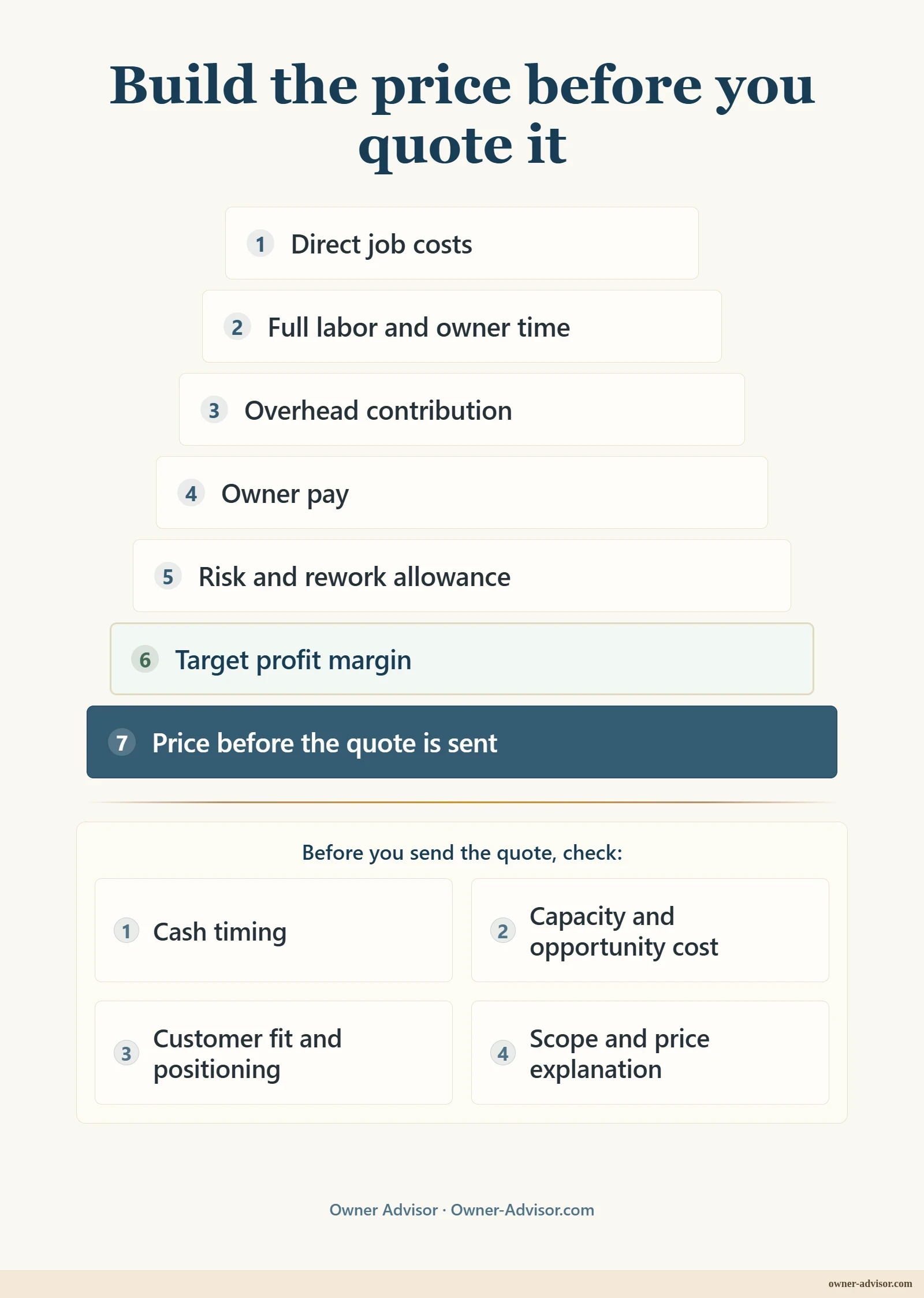
Apply four final checks
Cash timing
A profitable job can still create cash pressure.
If a 50% deposit on a $2,990 quote brings in $1,495 but the business must spend $1,750 before the next customer payment, it must fund a $255 gap plus other payroll and overhead due during that period.
The answer may be:
- a larger deposit;
- progress billing;
- shorter terms;
- a different purchasing schedule;
- enough working cash to carry the gap.
A higher final price does not solve a timing problem when the money arrives too late.
Capacity
A job may cover its costs and still be too cheap for the capacity it consumes.
Ask what the crew, equipment, calendar space, and owner attention could be used for instead.
When capacity is tight, minimum charges, tighter service areas, scheduling premiums, job selection, or saying no may protect the business better than adding volume.
Customer fit
Price helps determine the customers and work the business attracts.
A lower price may bring more inquiries but also more comparison shopping, discount pressure, and high-touch work.
A higher price may require stronger proof, clearer scope, better communication, and a more dependable customer experience.
The question is whether the price fits the service level, reputation, capacity, and work the business wants more of.
Scope and explanation
Before sending the quote, confirm:
- the scope is specific;
- direct costs are current;
- loaded labor and owner time are included;
- overhead uses a repeatable method;
- normal risk uses historical evidence where available;
- the intended margin is deliberate;
- deposits and payment timing support delivery;
- the work is worth the capacity it consumes;
- the customer can understand what is included.
If the quote depends on luck, free owner time, perfect execution, or faster-than-agreed payment, it needs another look.
What if the customer says the price is too high?
Customer pushback is information, not an instruction to discount.
Suppose the proposed price is $2,990 and the customer says they expected $2,500.
Do not immediately remove $490.
First ask what they are comparing.
A useful response might be:
"I understand. The $2,990 includes the full scope we discussed, including preparation, disposal, and the follow-up work after installation. We can look at a smaller option or phase the work, but I do not want to remove something from the price without being clear about what changes."
If the customer needs a lower total, adjust one of the drivers:
- reduce scope;
- change materials or options;
- phase the work;
- change timing;
- adjust service level;
- remove a clearly defined item.
Do not remove margin while leaving the same scope, labor, risk, and service promise in place.
The price may still be wrong. But the objection may also mean the scope is unclear, the customer is comparing a different service, trust has not been established, or the customer is not a fit.
Rebuild one recent price
Choose one common completed job and create a simple worksheet.
Step 1: Direct costs
Record:
- materials;
- supplies;
- subcontractors;
- permits;
- freight;
- disposal;
- fees.
Direct-cost total: __________
Step 2: Labor and owner time
Record:
- total crew hours, including surrounding job time: __________
- loaded labor rate: __________
- loaded crew cost: __________
- owner hours: __________
- owner hourly value: __________
- owner-time cost: __________
Step 3: Overhead
Choose one method.
For the hourly method, use the same definition used to calculate the annual rate:
- overhead rate per billable production hour: __________
- billable production hours for this job (this will often be fewer than the total crew hours above): __________
- overhead assigned to the job: __________
Or:
- overhead per comparable job: __________
Step 4: Risk and rework
Record:
- historical rework or callback rate: __________
- pre-risk subtotal: __________
- risk allowance for this job: __________
Step 5: Cost base
Direct costs + labor + owner time + overhead + risk = cost base
Cost base: __________
Step 6: Target margin
Record:
- recent margin on similar work: __________
- adjustment for risk: __________
- adjustment for capacity: __________
- adjustment for reinvestment or business needs: __________
- target margin: __________
Step 7: Target price
Target price = cost base / (1 - target margin)
Target price: __________
Step 8: Final checks
Confirm:
- cash timing works;
- capacity is available;
- the customer and work are a good fit;
- the scope is clear;
- the quote can be explained calmly.
Then compare the expected result with what actually happened after the job was completed.
The Pricing and Job-Profitability Workbook is available through Owner Advisor's Free Business Tools. The worksheet above remains usable on its own. Pricing becomes easier when the owner no longer has to defend a number chosen from instinct. The price can be explained because the assumptions behind it are visible.
Free tool
Service Price Floor Calculator
Estimate a minimum viable service price using direct costs, labor and owner time, overhead, risk, and target margin.
Get the Pricing and Job-Profitability Workbook
Move from a single price check to full job economics.
Related Business Guides
Get the Monthly Owner Guide
Get practical questions and decision tools for working through pricing, margins, cash, capacity, and what deserves attention next—before another busy job turns into work the business wishes it had priced differently.
Owner Advisor Business Guides are educational and practical. They do not replace legal, tax, accounting, HR, insurance, lending, or regulatory advice. Learn more about how we create and review our guides.
Browse Free Business Guides or read the Business Owner FAQ for what is available today.