

Free Business Guides
Markup vs. Margin: What’s the Difference, and Why Does It Matter?
Markup and margin describe the same gross-profit dollars from two different starting points. Confusing them can make a price look more profitable than it is.
What is the difference between markup and margin?
Markup and margin describe the same gross-profit dollars from two different starting points:
- Markup compares gross profit with cost.
- Margin compares gross profit with selling price.
If something costs $100 and sells for $150, the gross profit is $50. That equals a 50% markup but only a 33.3% gross margin.
Confusing the two can cause an owner to believe a price is producing more profit than it actually is.
They are not interchangeable.
How do you calculate markup?
The markup formula is:
Markup = (Selling price − Cost) ÷ Cost
Using the $100 cost and $150 selling price:
($150 − $100) ÷ $100 = 50% markup
Markup answers:
How much did I add to the cost?
To calculate a price using markup:
Selling price = Cost × (1 + Markup percentage)
A $100 cost with a 40% markup produces a $140 selling price.
How do you calculate margin?
The margin formula is:
Margin = (Selling price − Cost) ÷ Selling price
Using the same $100 cost and $150 selling price:
($150 − $100) ÷ $150 = 33.3% margin
Margin answers:
What percentage of the selling price remains after direct cost?
To calculate a price using a target margin:
Selling price = Cost ÷ (1 − Margin percentage)
A $100 cost with a 40% target margin requires a selling price of:
$100 ÷ 0.60 = $166.67
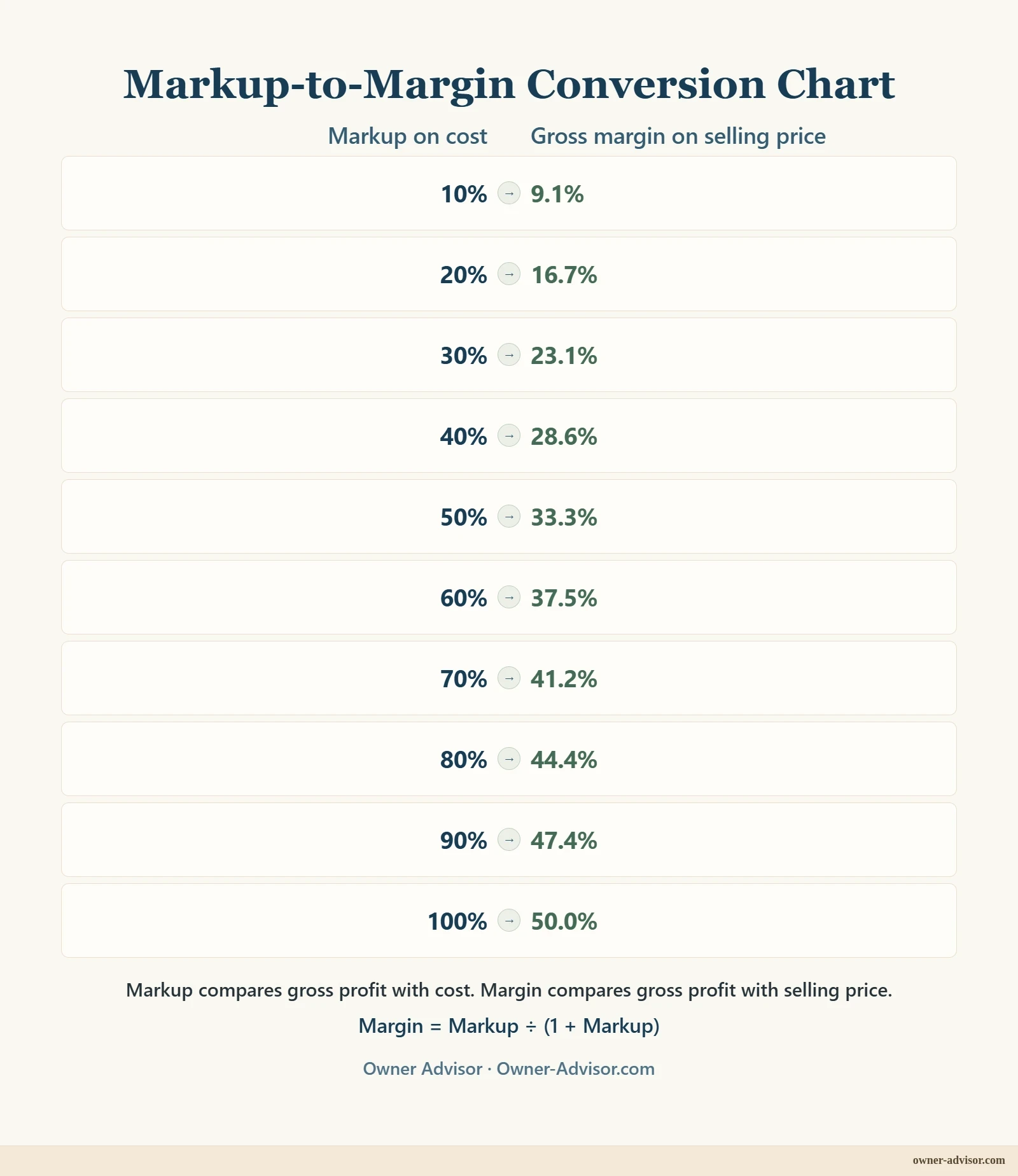
Markup-to-margin conversion chart
Use this conversion table when you know the markup on cost and need the equivalent gross margin on selling price.
| Markup | Gross margin |
|---|---|
| 10% | 9.1% |
| 20% | 16.7% |
| 30% | 23.1% |
| 40% | 28.6% |
| 50% | 33.3% |
| 60% | 37.5% |
| 70% | 41.2% |
| 80% | 44.4% |
| 90% | 47.4% |
| 100% | 50.0% |
A 100% markup means the business doubled its cost. It produces a 50% gross margin.

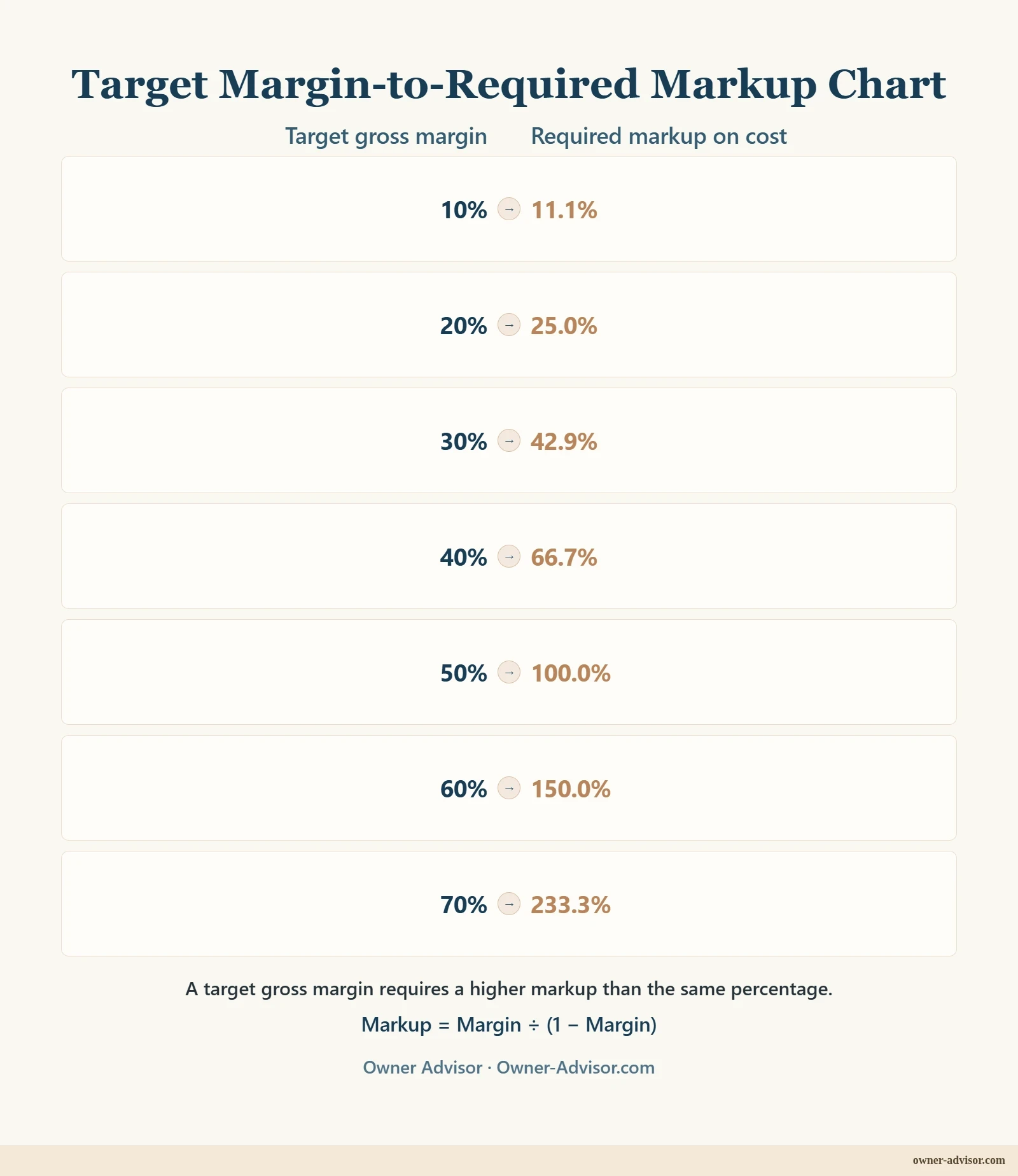
Margin-to-markup conversion chart
Many owners accidentally use the markup percentage they wanted as a margin percentage. The table below shows the markup actually required to reach each target gross margin.
| Desired gross margin | Required markup |
|---|---|
| 10% | 11.1% |
| 20% | 25.0% |
| 30% | 42.9% |
| 40% | 66.7% |
| 50% | 100.0% |
| 60% | 150.0% |
| 70% | 233.3% |

How do you convert from one to the other?
To convert markup into margin:
Margin = Markup ÷ (1 + Markup)
To convert margin into markup:
Markup = Margin ÷ (1 − Margin)
For example, a 50% markup converts to:
0.50 ÷ 1.50 = 33.3% margin
A 40% margin converts to:
0.40 ÷ 0.60 = 66.7% markup
These conversions matter when an estimator prices with markup while the owner reviews financial results using gross margin.
Which costs belong in the calculation?
Use this rule:
A cost is usually direct when the business incurs it because it performed that specific job, delivered that specific service, or sold that specific product.
For a contractor, direct costs may include:
- materials;
- field labor;
- labor burden;
- subcontractors;
- equipment used specifically for the job;
- permits;
- disposal;
- job-specific travel or delivery.
Labor burden means employer costs added to wages, such as payroll taxes, workers’ compensation, and employee benefits.
For a professional-service firm, direct costs may include the delivery team’s time, contractors, project-specific software, or outside services required for the engagement.
For a retailer or product business, direct costs may include product cost, inbound freight, duties, packaging, merchant fees, and fulfillment.
General office rent, bookkeeping, administrative payroll, broad marketing, and company-wide software are usually overhead rather than direct costs.
The distinction matters because leaving a real direct cost out makes the estimated margin look stronger than the actual result.
How do markup and margin fit into pricing?
Markup or margin is only one part of the price.
Use this sequence:
- Identify every direct cost required to perform the work.
- Include labor burden and other easily missed costs.
- Choose a target gross margin.
- Calculate the required selling price.
- Confirm that the gross-profit dollars help cover overhead.
- Decide whether enough operating profit remains for the risk and effort involved.
- Compare estimated margin with actual margin after delivery.
Suppose a contractor estimates $6,000 of direct cost and wants a 40% gross margin.
The required selling price is:
$6,000 ÷ 0.60 = $10,000
Expected gross profit is:
$10,000 − $6,000 = $4,000
Those $4,000 of gross profit must still help cover office payroll, insurance, vehicles, software, rent, and operating profit.
A mathematically correct margin can still be too low if the company’s overhead or risk requires more gross-profit dollars.
What does a pricing problem look like?
Is estimated margin strong, but actual margin weak?
Investigate missing costs, labor overruns, waste, rework, discounts, material increases, and unpriced scope changes.
Are jobs meeting their margin target while company profit stays weak?
The margin target may not be high enough to support overhead, or overhead may be too high for the current sales level.
Do prices look profitable while cash remains tight?
Review deposits, billing milestones, receivables, inventory, debt payments, and owner withdrawals. Margin and cash timing are different questions.
Is the same markup used for every type of work?
Different jobs may require different margins because risk, capacity demands, selling effort, warranty exposure, and customer payment terms vary.
Do estimates and actual reports use different cost definitions?
Standardize which costs count as direct so estimates and completed-job reviews measure the same thing.
What are the most common markup and margin mistakes?
- Using markup when the target was stated as margin
- Leaving labor burden or other direct costs out
- Treating gross margin as final company profit
- Using one percentage for every kind of work
- Reviewing estimated margin but not actual margin
A job may be priced correctly and still lose margin during delivery. Pricing discipline includes both the estimate and the follow-up.
What should you do next?
Review several recent jobs, products, or services and record:
- complete direct cost;
- selling price;
- gross-profit dollars;
- markup percentage;
- margin percentage;
- estimated margin;
- actual margin;
- reason for any difference.
If margins are consistently below target, identify whether the cause is pricing, missing costs, delivery performance, purchasing, discounting, or scope control before assuming the business simply needs more sales.
What kind of help do you need next?
If you understand the conversion but are unsure what margin your prices need to support, continue with How to Price Service Jobs Without Guessing, Why Is My Business Busy but Not Profitable?, and How Do I Read and Use a Profit and Loss Statement for My Small Business?
Owner Advisor is being built to help owners connect pricing, direct costs, overhead, capacity, and cash instead of reviewing each one separately.
Key takeaways
- Markup compares gross profit with cost.
- Margin compares gross profit with selling price.
- A 20% markup produces a 16.7% margin.
- A 50% margin requires a 100% markup.
- Use the complete direct cost in the calculation.
- Gross profit still has to cover overhead and operating profit.
- Compare actual margin with estimated margin after the work is complete.
Free tool
Markup vs. Margin Calculator
Convert between markup and margin, check a price against cost, and see the gross-profit dollars that remain.
Related Business Guides
Read More Free Business Guides
Continue with the free Business Guides, Free Business Tools, and Business Owner FAQ for practical help available today.
Owner Advisor Business Guides are educational and practical. They do not replace legal, tax, accounting, HR, insurance, lending, or regulatory advice. Learn more about how we create and review our guides.
Browse Free Business Guides or read the Business Owner FAQ for what is available today.