

Free Business Guides
Should I Run Ads for My Small Business?
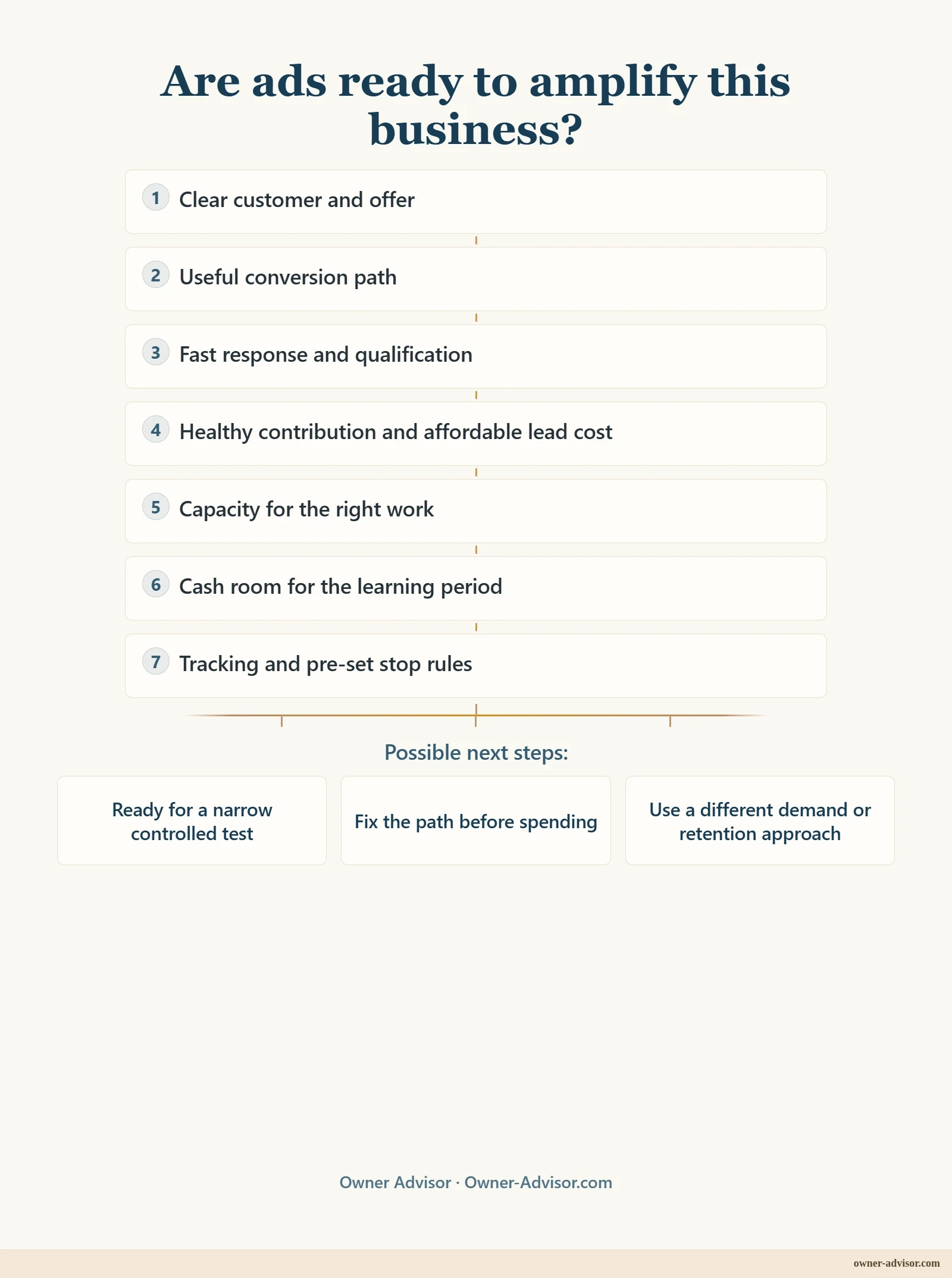
Run ads when you have a clear customer and offer, a reliable path for handling leads, healthy customer economics, enough capacity and cash to learn, and tracking that connects spending to qualified, profitable work.
Ads solve a specific demand problem
Ads should be a controlled demand test, not a rescue plan.
They amplify the path they feed.
That can mean amplifying a strong offer and disciplined follow-up. It can also mean making poor fit, slow response, weak pricing, and capacity strain more expensive.
Paid advertising can help you:
- reach people who do not already know the business;
- create demand for a defined offer;
- fill a specific service window;
- retarget interested prospects;
- test a customer-message-channel combination;
- generate qualified inquiries for available capacity.
Ads do not repair:
- late quoting;
- unclear scope;
- weak customer fit;
- underpriced work;
- poor follow-up;
- delivery problems;
- slow collections;
- an owner who cannot respond to leads.
Before spending, state the problem the campaign is meant to solve.
"Get more business" is too broad.
A stronger objective is:
Generate qualified inquiries for weekday maintenance appointments within a 20-mile service area.
Pass seven readiness gates
1. Is the customer and offer specific?
A useful test needs one understandable offer for a defined customer problem, location, timing, or use case.
A stranger should quickly understand:
- what you offer;
- who it is for;
- why it matters;
- what to do next.
Broad ads often generate broad, expensive confusion.
2. Is the path after the ad clear?
The ad should lead to a relevant:
- page;
- call;
- message;
- form;
- booking step;
- quote request.
The customer should not need to search the website to understand the next action.
Review the entire path on a phone before launch.
The wording in the ad, page, form, and first response should describe the same offer. A campaign can attract the right person and still lose them when the next step feels unrelated, confusing, or unsafe.
3. Can you respond and qualify reliably?
Decide:
- who receives the lead;
- how quickly the first response should occur;
- what happens when that person is unavailable;
- what information is collected;
- how customer fit is judged;
- what the next step will be.
You pay for the opportunity whether or not anyone follows up well.
Why Am I Getting Leads but Not Sales? helps diagnose that path when inquiries already exist but are not becoming healthy sales.
4. Can the economics support paid acquisition?
Revenue is not the amount available to acquire a customer.
Start with the contribution from one good acquired customer after:
- direct labor or product cost;
- materials;
- transaction cost;
- sales effort;
- rework;
- customer-specific delivery or support cost.
Then connect that contribution to qualification and close rates.
How to Price Service Jobs Without Guessing can help when customer contribution is unclear because the underlying service price or full cost base has not been rebuilt.
Calculate a break-even lead-cost ceiling
Suppose one good customer produces:
- Revenue: $2,500
- Contribution after direct and customer-specific costs: $1,000
Suppose 25% of qualified leads become customers.
Break-even cost per qualified lead:
$1,000 x 25% = $250
If only 60% of raw leads qualify, then:
60% qualified x 25% close rate = 15% of raw leads become customers
Break-even raw lead cost:
$1,000 x 15% = $150
Those are mathematical ceilings, not sensible target costs.
Spending the full $250 per qualified lead would use all $1,000 of expected contribution to acquire the customer.
It would leave no room for:
- fixed overhead;
- profit;
- owner return;
- uncertainty;
- weaker-than-expected leads;
- platform or agency cost;
- delayed collection.
Set an operating target below break-even.
Suppose you decide to protect 60% of the $1,000 contribution for overhead, profit, uncertainty, and business needs.
Marketing amount available per customer:
$1,000 x 40% = $400
Operating target per qualified lead:
$400 x 25% = $100
Operating target per raw lead:
$400 x 15% = $60
The 40% acquisition allowance is a planning decision, not a universal rule. Adjust it for cash, risk, sales effort, repeat business, and how reliable the conversion history is.
If sales are increasing but the business still does not keep enough money, Why Is My Business Busy but Not Profitable? helps determine whether the real problem is pricing, work mix, hidden time, rework, or overhead rather than insufficient demand.

5. Can you serve the demand you want?
Check:
- schedule;
- people;
- materials;
- inventory;
- owner attention;
- estimating capacity;
- cash needed to start the work.
The goal may be better-fit demand rather than more total demand.
Ads can damage trust when they create inquiries the business cannot answer, schedule, or serve well.
Do not advertise work merely because it has open capacity. Confirm that the work is profitable, manageable, and something you would want more of.
6. Can cash carry the learning period?
Treat the initial test as learning money, not guaranteed immediate return.
Count more than platform spend.
Total test risk = ad spend + setup cost + sales effort + test-specific delivery cost + reserve
Setup may include:
- creative;
- landing-page work;
- call tracking;
- agency or contractor setup;
- software;
- offer development.
Sales effort may include owner or employee time spent responding, qualifying, quoting, and following up.
Also consider the delay between:
- lead;
- sale;
- delivery;
- invoice;
- collected cash.
A test can be economically promising and still create a short-term cash gap.
Do not use money needed for payroll, taxes, critical vendors, debt, or operating reserve.
Why Is Cash Flow Tight Even When Business Is Good? helps separate a profitable marketing opportunity from a test the business cannot safely carry through its collection cycle.
7. Can you track and make a decision?
At minimum, connect spending to:
- inquiries;
- qualified leads;
- contact;
- quotes or next steps;
- sales;
- collected revenue;
- contribution;
- customer fit;
- delivery result.
Set the review date and stop, change, or continue rules before launch.
Without those rules, platform dashboards, one exciting sale, or sunk cost can drive the decision.
Build a controlled first test
Define one experiment.
Test:
- one primary customer;
- one offer;
- one conversion action;
- one channel;
- one defined review period.
Write down the single question the campaign should answer.
For example:
Can paid search produce qualified weekday maintenance inquiries within our service area at an operating target of no more than $60 per raw lead?
Then define:
- the customer;
- the offer;
- the conversion action;
- expected lead volume;
- qualification standard;
- expected close rate;
- operating target lead cost;
- maximum total test risk;
- buying-cycle length;
- review date.
Keep the landing path and follow-up process stable enough to interpret the result. Do not change the audience, offer, creative, page, budget, and follow-up every few days and expect a clear answer.
Define stop, change, and continue rules
Stop or pause
Pause when:
- leads are clearly poor fit;
- response is not happening;
- tracking is broken;
- cash is becoming unsafe;
- the page or offer is inaccurate;
- resulting work is unprofitable or unmanageable;
- the test exceeds its maximum planned loss.
Change
Change one important variable when the evidence points to a likely weakness, such as:
- audience;
- offer;
- page;
- qualification;
- follow-up;
- pricing;
- schedule fit.
Do not change everything at once.
Continue or cautiously increase
Continue only when:
- qualified demand is real;
- follow-up works;
- conversion is acceptable;
- customer economics support the spend;
- customer fit is healthy;
- capacity can serve the work;
- cash can carry the cycle.
A few clicks or one sale are not proof. The evidence needed depends on the cost, sales cycle, volume, and consequences of being wrong.
Ads may not be the best next channel
Ads are one demand channel, not the definition of marketing.
A business with strong past customers may get more value from:
- reactivation;
- repeat-service reminders;
- referrals;
- local partnerships;
- reviews;
- local search;
- useful content;
- relationship building.
A business with an unclear offer may need positioning and proof before paid reach.
Choose the channel that fits how your customers decide and how your business can follow through.
Make the final go-or-no-go decision
Review the seven gates and the test design one more time.
Proceed only when:
- all seven gates have credible answers;
- the campaign has one defined question;
- the test risk is affordable;
- stop, change, and continue rules are written;
- the team can execute the response and tracking plan as designed.
Delay the test when a missing answer would prevent you from interpreting the result or safely serving the work.
A delayed test is usually cheaper than paying to discover a problem you already knew was unresolved.
The Marketing and Sales Performance Scorecard is available through Owner Advisor's Free Business Tools. The calculations and review above remain usable on their own.
Advertising can involve platform policies, prohibited targeting, privacy and tracking rules, consent, call recording, email or SMS requirements, consumer-protection law, regulated claims, promotions, financing, endorsements, and industry-specific restrictions. Confirm applicable requirements with qualified legal, compliance, privacy, or advertising professionals.
Frequently asked questions
How much should I spend on my first ad test?
Base the budget on the economics, evidence needed, buying cycle, and maximum loss you can safely absorb.
Do not begin with the amount a platform recommends.
Should I run ads if I need sales quickly?
Be careful.
Ads may generate attention quickly, but qualification, quoting, delivery, and collection still take time. A business that urgently needs cash may not have enough room for the learning period.
Which ad platform should I use?
Choose the platform that reaches the defined customer in the context where the offer makes sense.
Platform choice comes after customer, offer, economics, response, capacity, and tracking, not before.
When should I increase the budget?
Increase only after the full path supports it: qualified demand, reliable response, acceptable acquisition economics, good-fit customers, profitable delivery, and enough capacity and cash.
Free tool
Break-Even Lead-Cost Calculator
Estimate break-even and operating lead-cost targets using customer contribution, qualification rate, and close rate.
Get the Marketing and Sales Performance Scorecard
Pair ads readiness with ongoing scorecard tracking.
Related Business Guides
- Why am I getting leads but not sales?
- Why is my business busy but not profitable?
- How to price jobs without guessing
- Why is cash flow tight even when business is good?
- How much should a small business spend on marketing?
- How much should I spend testing ads?
- How do I know if my marketing is working?
- Which marketing channels bring better customers?
Read More Free Business Guides
Continue with the free Business Guides, Free Business Tools, and Business Owner FAQ for practical help available today.
Owner Advisor Business Guides are educational and practical. They do not replace legal, tax, accounting, HR, insurance, lending, or regulatory advice. Learn more about how we create and review our guides.
Browse Free Business Guides or read the Business Owner FAQ for what is available today.