

Free Business Guides
How Do I Read and Use a Balance Sheet for My Small Business?
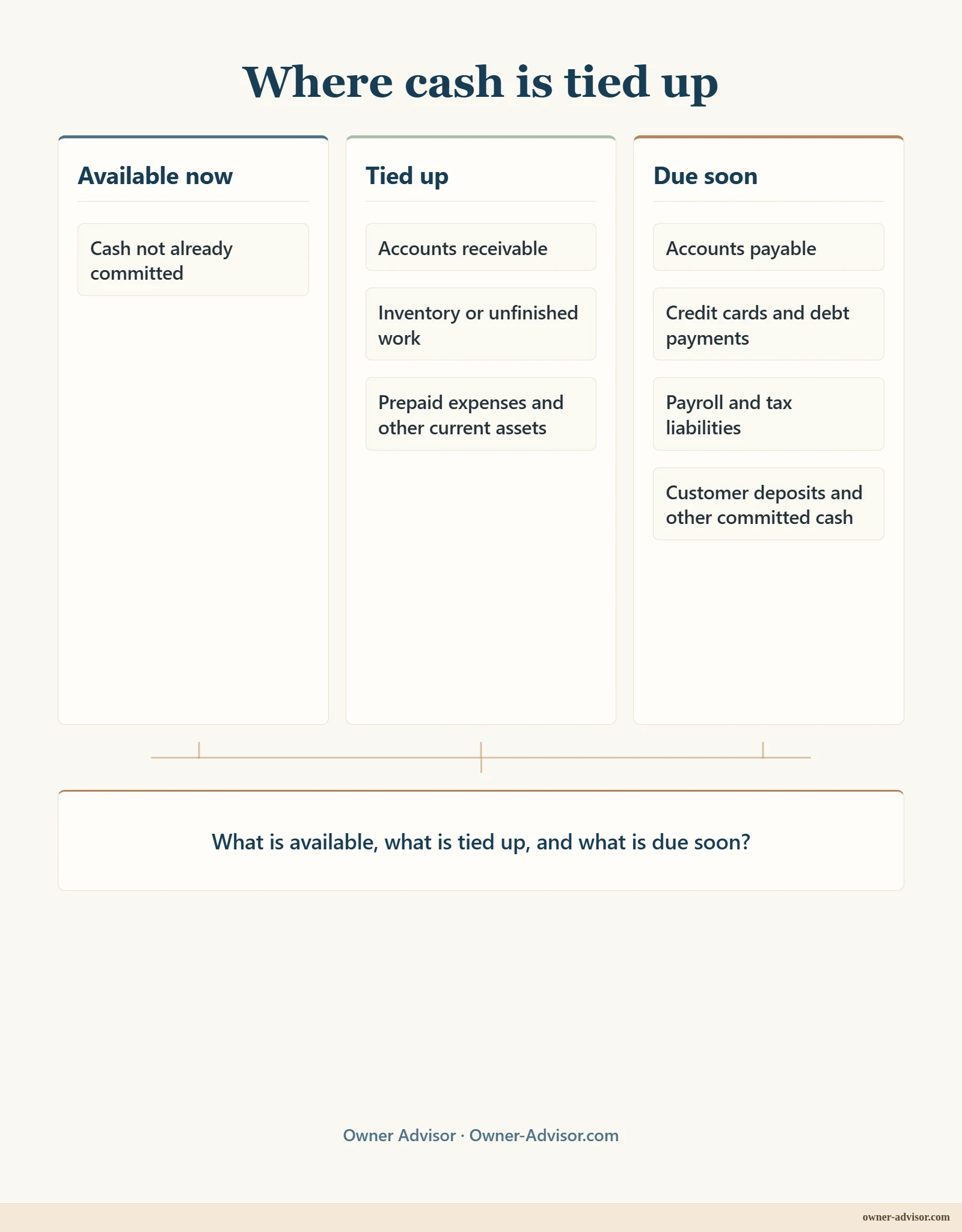
A balance sheet shows the financial position of the business on one specific date and helps an owner see what is available, what is tied up, and what is due soon.
How should a small-business owner read and use a balance sheet?
A balance sheet shows the financial position of the business on one specific date.
Use it to answer four questions:
- 1. Can the business cover what it owes soon?
- 2. Is too much money tied up in receivables, inventory, or unfinished work?
- 3. Is debt helping the business grow or hiding an operating problem?
- 4. Is the financial position getting stronger or weaker?
The basic equation is assets equal liabilities plus equity. Assets are what the business owns or controls. Liabilities are what it owes. Equity is the accounting amount left after liabilities are subtracted from assets. The P&L explains how the business performed over a period. The balance sheet shows where the business stands today.
Can the business pay its bills?
Start with liquidity: the ability to cover obligations coming due.
Current assets are expected to become cash, be sold, or be used within about one year. They commonly include cash, accounts receivable, inventory, short-term deposits, and prepaid expenses.
Current liabilities are generally due within about one year. They commonly include accounts payable, credit cards, payroll and sales-tax liabilities, customer deposits, short-term loans, and the portion of longer-term debt due during the next year.
Not every current asset is equally useful.
Cash may be available immediately. Receivables still need to be collected. Inventory still needs to be sold. Prepaid insurance may reduce a future cost, but it cannot fund payroll this week.
Some cash may also already be committed. Payroll taxes, sales taxes, and customer deposits can sit in the bank without being available for ordinary spending.
Ask how much cash is truly available after payroll, taxes, supplier bills, and debt payments coming due.

What do working capital and the current ratio tell you?
Working capital is current assets minus current liabilities.
For example:
- Current assets: $140,000
- Current liabilities: $95,000
- Working capital: $45,000
Positive working capital usually gives the business more room to meet near-term obligations. Negative working capital can signal pressure.
The current ratio uses the same categories: current assets divided by current liabilities.
Using the example above, $140,000 / $95,000 = 1.47.
A ratio above 1.0 means current assets exceed current liabilities. A ratio below 1.0 means the business owes more within the next year than it currently holds in current assets.
The right level varies. A cash-based service company may need less working capital than a contractor waiting 60 days for payment or a retailer carrying several months of inventory.
A high current ratio is not automatically good. It may reflect old receivables, excess inventory, or cash that is sitting idle.
Use the ratio as a warning signal, not a final judgment.
Is too much money tied up in receivables?
Accounts receivable is money customers owe the business.
A growing receivable balance may mean sales are increasing. It may also mean invoices are late, customers are paying more slowly, disputes are growing, or old balances are not being collected.
The balance sheet shows the total. The receivable-aging report shows how old the invoices are.
A contractor may have progress billings, approved change orders, or retainage outstanding after already paying labor, materials, and subcontractors.
A professional-service firm may have completed work but delayed invoicing. Until the invoice goes out, the collection clock has not started.
If receivables rise faster than sales, the business may have a billing or collection problem rather than a sales problem.
Is too much money tied up in inventory or unfinished work?
Inventory is recorded as an asset, but it represents cash that has already left the bank.
An HVAC or plumbing business may hold parts, fittings, refrigerant, or equipment. A retailer may hold seasonal products. A manufacturer may carry raw materials, work in process, and finished goods.
Inventory becomes a concern when it grows faster than sales or sits too long.
That may mean the business is buying ahead of demand, carrying obsolete stock, holding too many products, or experiencing production delays.
Contractors and project businesses may also have unbilled work or work in process. The company may have spent money completing part of a job without reaching the next billing milestone.
If inventory or unbilled work keeps increasing while cash falls, review purchasing, billing terms, job progress, and project delays before assuming the answer is simply more sales.
Is debt helping the business grow or helping it survive?
Debt is not automatically good or bad. Its purpose matters.
Debt may support growth when it finances:
- a productive vehicle;
- equipment that increases capacity;
- inventory tied to known demand;
- a short-term timing gap with a clear repayment source.
Debt is more concerning when it repeatedly covers payroll, supplier bills, owner withdrawals, operating losses, or credit-card balances that never decline.
A contractor may finance a truck that helps add a profitable crew. That debt may support productive capacity.
The same contractor may use a line of credit every month because jobs are underpriced or customers pay slowly. That debt may be hiding an operating problem.
For each debt balance, ask:
- What was the money used for?
- What is the monthly payment?
- What cash flow is expected to repay it?
- Is the balance declining as planned?
If debt keeps rising without a matching increase in productive assets or profit, identify the problem the borrowing is covering before adding more.
What does equity actually tell you?
Equity is the accounting amount remaining after liabilities are subtracted from assets.
It may include owner contributions, accumulated profits or losses, and owner withdrawals or distributions.
Equity is not the same as the amount someone would pay for the business. The balance sheet may not capture customer relationships, workforce knowledge, reputation, brand strength, or future earning potential.
Owner draws and distributions may reduce equity without appearing as operating expenses on the P&L. Their treatment depends partly on the entity and accounting setup.
Negative equity deserves investigation, but it does not automatically prove the business cannot operate. It may reflect accumulated losses, large distributions, historical transactions, or inaccurate balances.
How should you use the balance sheet to decide what to do next?
If the current ratio is below 1.0 or falling steadily
Review the next 30 to 90 days of payroll, taxes, supplier bills, debt payments, and expected collections before taking on new spending.
If receivables are rising faster than sales
Review billing speed, payment terms, retainage, disputed invoices, and collection follow-up.
If inventory is growing while sales stay flat
Review purchasing, obsolete stock, slow-moving items, project delays, and whether inventory matches real demand.
If debt is increasing every month
Separate borrowing that supports productive growth from borrowing that covers routine operating shortfalls.
If cash is falling while the P&L shows profit
Review receivables, inventory, equipment purchases, loan principal, owner draws, customer deposits, and other working-capital uses.
The goal is not to react to every balance. It is to identify the one or two changes most likely to create cash pressure or limit the next business decision.
What should you do after reviewing the balance sheet?
Write down:
- what changed;
- why you think it changed;
- what money is available;
- what money is tied up;
- what is due soon;
- the next action;
- when you will review it again.
What kind of help do you need next?
If the report appears accurate but you are unsure what it means for cash, debt, hiring, spending, or what deserves attention first, Owner Advisor is being built to help owners connect those decisions over time.
If the books do not reconcile, balances appear inaccurate, or a tax, lending, or formal accounting decision depends on the statement, ask a qualified bookkeeper, accountant, or CPA to review it.
Key takeaways
- The balance sheet shows the business’s financial position on one date.
- Current assets are not the same as available cash.
- Working capital equals current assets minus current liabilities.
- The current ratio compares current assets with current liabilities.
- Receivables, inventory, and unfinished work can tie up cash even when the business is profitable.
- Debt should be judged by what it funds and how it will be repaid.
- Book equity is not the market value of the business.
- Use changes in the balance sheet to decide what deserves investigation next.
Get the Monthly Financial Review Workbook
Use the balance-sheet review tab with this guide.
Related Business Guides
Owner Advisor Business Guides are educational and practical. They do not replace legal, tax, accounting, HR, insurance, lending, or regulatory advice. Learn more about how we create and review our guides.
Browse Free Business Guides or read the Business Owner FAQ for what is available today.