

Free Business Guides
Can I Afford to Hire Someone for My Small Business?
You can usually afford a hire when profitable, repeatable work can support the full cost of the role, cash can carry payroll through the ramp-up period, and the person will own a clearly defined constraint.
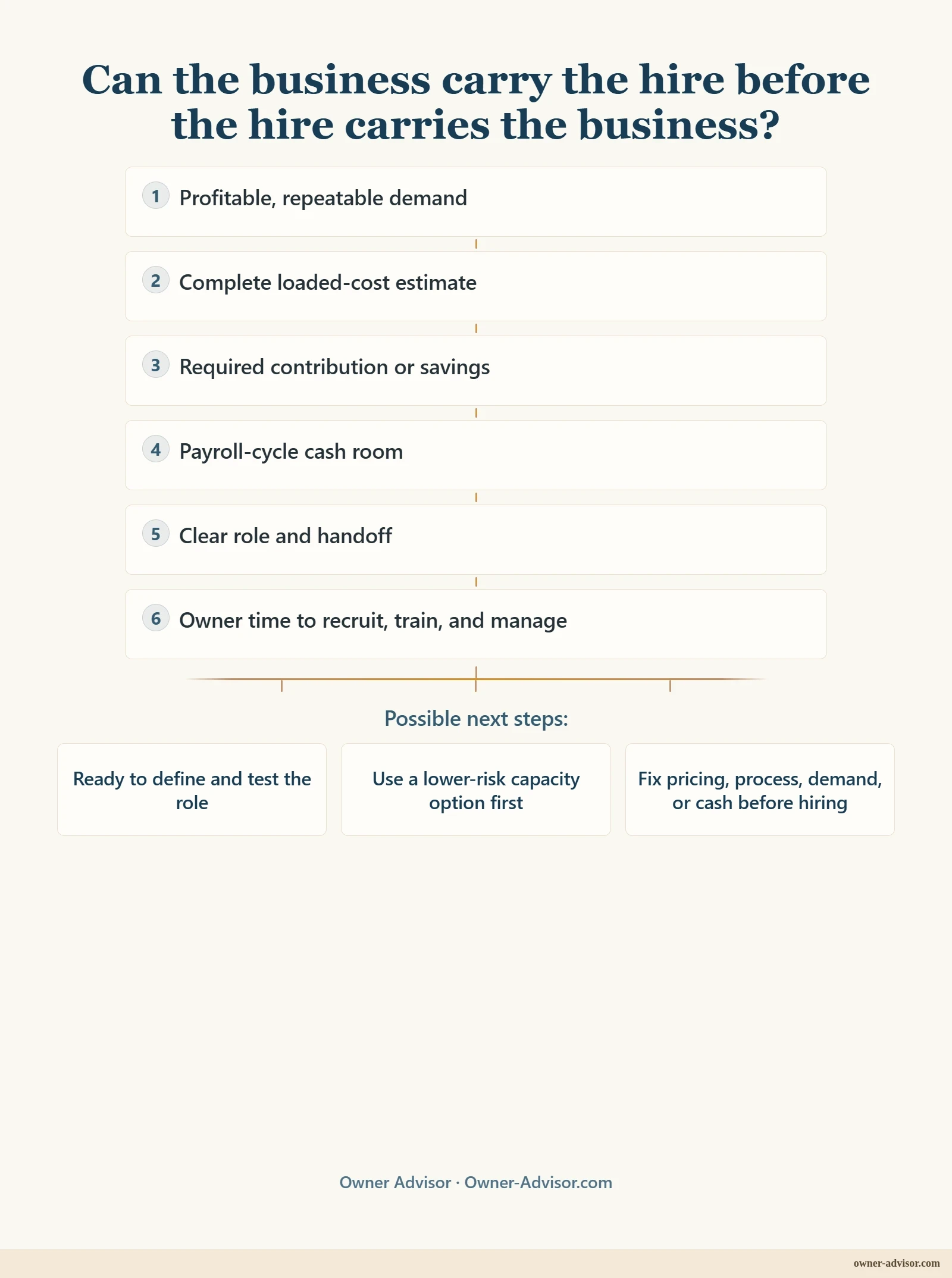
Before hiring, answer six questions
Wages alone are not the affordability test.
Before hiring, answer six questions:
- 1. Is the demand profitable and repeatable?
- 2. What is the full first-year and ongoing cost?
- 3. How much contribution or savings must the role create?
- 4. Can cash carry the role before the payoff arrives?
- 5. Is the role clear enough to hand off?
- 6. Do you have time to recruit, train, and manage the person?
A hire can create breathing room. It can also add payroll to a pricing, cash, process, or management problem that has not been fixed.
Start with the problem the hire should solve
Do not begin with:
"We are too busy. We need another person."
Begin with:
"What specific constraint is preventing profitable work from moving forward?"
Examples include:
- qualified leads wait too long for a response;
- estimates are delayed because only the owner can prepare them;
- crews lose productive time to material runs;
- invoices go out late;
- rework is increasing because quality checks are inconsistent;
- the owner spends too much time on scheduling or administration;
- profitable work is being delayed or declined because delivery capacity is full.
A vague role such as "help with everything" usually means the operating decision is not finished.
The hire should own a defined result, not merely absorb whatever the owner cannot get to that day.
This guide uses capacity and bottleneck evidence to answer a hiring question: would another person remove a valuable, repeatable constraint? It does not assume that every workload problem requires more payroll.
Calculate the full loaded cost
Loaded employee cost is the full cost of employing and supporting the person, not just wages or salary.
Depending on the role and business, include:
- wages or salary;
- employer payroll taxes;
- workers' compensation;
- unemployment insurance;
- health, retirement, or other benefits;
- paid time off;
- recruiting;
- background checks or screening;
- onboarding and training;
- tools, software, phone, uniforms, or equipment;
- vehicle or mileage support;
- workspace;
- supervision and management time;
- expected ramp-up inefficiency.
Some costs continue every year. Others are concentrated in the first year.
Separate them so you do not mistake a first-year cost for the permanent annual run rate.
A worked loaded-cost example
Suppose you are considering a full-time employee at $24 per hour for 40 hours per week.
Base annual wages:
$24 x 40 hours x 52 weeks = $49,920
Estimated recurring annual costs:
- Employer payroll taxes and required payroll costs: $5,000
- Workers' compensation, insurance, and benefits: $6,500
- Tools, software, phone, uniforms, or vehicle support: $4,000
Recurring annual loaded cost:
$49,920 + $5,000 + $6,500 + $4,000 = $65,420
Estimated first-year-only or ramp-up costs:
- Recruiting, onboarding, and initial training: $3,500
- Expected ramp-up inefficiency and additional management time: $6,000
First-year planning cost:
$65,420 + $3,500 + $6,000 = $74,920
Average first-year monthly cost:
$74,920 / 12 = about $6,243 per month
Ongoing monthly run rate after the initial ramp-up:
$65,420 / 12 = about $5,452 per month
These are planning estimates, not payroll or legal calculations. Use your actual payroll, insurance, benefits, equipment, and operating facts.
The important point is that a $49,920 wage decision can become a $74,920 first-year commitment.

Calculate the value the role must create or protect
A role does not always need to generate direct sales.
It may create value by:
- increasing delivery capacity;
- protecting profitable work;
- improving response or quote speed;
- reducing rework;
- speeding billing and collections;
- lowering subcontractor or overtime cost;
- returning owner time to higher-value work;
- preventing customer or employee loss.
Estimate the annual value using the categories that actually apply.
Added contribution from more work
Use contribution, not revenue.
Suppose the role needs to support its $74,920 first-year cost entirely through additional work.
If added revenue produces a 40% contribution margin before the new employee's fixed cost:
Required added revenue = $74,920 / 40%
Required added revenue = $187,300
At a 40% contribution margin:
$187,300 x 40% = $74,920
That does not mean every hire must generate $187,300 of sales.
It means approximately $187,300 of additional collected revenue would be needed to create $74,920 of contribution if added revenue were the role's only source of value.
Savings and protected value
The role may justify itself through several kinds of value.
For example:
- Added contribution from increased capacity: $30,000
- Reduced overtime or subcontractor cost: $15,000
- Lower rework and callback cost: $9,920
- Owner time redirected to estimating, sales, or management: $20,000
Total estimated value:
$30,000 + $15,000 + $9,920 + $20,000 = $74,920
That exactly matches the first-year planning cost in this example.
The estimates still need evidence. Matching the cost on paper does not make the hire risk-free.
Do not count the same benefit twice. For example, do not count both the contribution from added jobs and the full value of owner time used to produce those same jobs unless they are genuinely separate benefits.
Test whether the demand is steady and worth expanding
Do not hire from one unusually busy week or a pipeline full of uncertain work.
Look for evidence such as:
- profitable work is consistently delayed or declined;
- good-fit customers are waiting;
- overtime or subcontracting has become regular;
- the same constraint appears week after week;
- the owner repeatedly performs work that could be transferred;
- the role would support a service the business wants more of;
- the supporting customers pay reliably.
A full calendar is not enough.
The calendar may be full of:
- underpriced work;
- poor-fit customers;
- excessive customization;
- slow-paying jobs;
- rework;
- owner-dependent processes.
Adding capacity for weak work can make the business larger and more fragile.
Why Is My Business Busy but Not Profitable? helps determine whether the real constraint is capacity or weak job economics.
How to Price Service Jobs Without Guessing helps rebuild the cost and margin assumptions when the supporting work may be underpriced.
Check whether cash can carry the ramp-up
A hire can make sense annually and still create a dangerous short-term cash gap.
Payroll starts on a fixed schedule.
The added revenue, savings, or owner capacity may arrive later.
Add the hire to a 13-week cash forecast.
Include:
- recruiting and setup;
- first payroll dates;
- payroll taxes;
- insurance;
- tools and equipment;
- training time;
- lower productivity during ramp-up;
- customer payment timing;
- a realistic delay before the role creates full value.
Suppose the hire requires:
- $4,500 of recruiting, setup, and equipment before the first day;
- $12,500 of payroll and related cash during the first eight weeks;
- $2,500 of additional training and management cost.
Cash required before full productivity:
$4,500 + $12,500 + $2,500 = $19,500
Now suppose the added work does not begin producing collected contribution until Week 9.
You need enough available cash to carry the $19,500 before the expected payoff arrives, while still protecting payroll, taxes, vendors, debt, and operating reserve.
Run a downside case:
- a large customer pays late;
- the expected work starts one month later;
- the employee needs more training;
- sales soften;
- equipment costs more than planned.
Why Is Cash Flow Tight Even When Business Is Good? explains how to identify the lowest-cash week and separate a timing problem from weak economics.
Define the role and handoff
Before recruiting, write down:
- the constraint the role should remove;
- the work the person will own;
- the decisions they can make;
- the information and tools they need;
- the standard for acceptable work;
- the point when they should escalate;
- what success should look like after 30, 60, and 90 days.
A useful role should become more independent over time.
If every decision still returns to you, payroll has increased but owner capacity has not.
A handoff also requires a basic operating method.
That may be:
- an intake checklist;
- scheduling rules;
- a job packet;
- estimating assumptions;
- a quality standard;
- a billing trigger;
- an approval threshold.
Do not wait for a perfect manual. Create the smallest process that lets a capable person perform the role consistently.
Check your management capacity
Hiring usually adds work before it removes work.
Someone must:
- recruit;
- interview;
- prepare the role;
- onboard;
- train;
- answer questions;
- review work;
- correct mistakes;
- give feedback;
- reinforce standards.
Estimate that time before making the commitment.
Suppose you expect:
- 25 hours to recruit and interview;
- 20 hours to prepare tools and processes;
- 40 hours of onboarding and early training;
- 3 hours per week of management during the first 12 weeks.
Initial owner-management time:
25 + 20 + 40 + (3 x 12) = 121 hours
If your owner-time planning value is $60 per hour:
121 hours x $60 = $7,260 of owner-management value
That does not necessarily belong in payroll expense. It belongs in the hiring decision because the time is real and must come from somewhere.
Consider a lower-risk test
The right answer is not always a permanent full-time employee.
Depending on the work and applicable requirements, you may test:
- part-time help;
- seasonal staffing;
- temporary support;
- outsourced bookkeeping or administration;
- specialized professional help;
- subcontracted capacity;
- internal reassignment;
- a process or software change.
Choose the smallest test that can answer whether the role actually removes the constraint.
For example, before hiring a full-time administrator, you might test 15 hours per week for eight weeks with defined ownership of scheduling, invoicing, and customer follow-up.
Set the evidence in advance:
- tasks transferred;
- owner hours released;
- invoices sent faster;
- fewer scheduling errors;
- customer response time improved;
- enough recurring work to justify expanding the role.
A contractor or outsourced arrangement does not automatically avoid employment, tax, insurance, or classification requirements. The actual relationship and applicable rules matter.
When not to hire yet
Delay or redesign the hire when:
- supporting work is underpriced;
- demand is temporary or uncertain;
- customers pay unreliably;
- normal payroll already depends on debt;
- the role is vague;
- the process creates repeated rework;
- the owner cannot train or manage the person;
- the business cannot carry the ramp-up period;
- the expected value depends on optimistic sales assumptions;
- a smaller test could answer the question first.
The hiring idea may still be right.
The sequence may be wrong.
Pricing, collections, role design, work mix, or a minimum process may need attention first.
Run a hiring-readiness review
Before recruiting, record:
- 1. The exact constraint the role should remove.
- 2. The work the person will own after 30, 60, and 90 days.
- 3. Base annual wages or salary.
- 4. Recurring loaded annual cost.
- 5. First-year recruiting, setup, training, and ramp-up cost.
- 6. Monthly recurring run rate.
- 7. Added contribution, savings, and owner value expected.
- 8. Evidence supporting each value estimate.
- 9. Cash required before the role reaches expected productivity.
- 10. Lowest-cash week in the downside case.
- 11. Demand supporting the role.
- 12. Process, tools, standards, and authority the person will use.
- 13. Owner time required to recruit, train, and manage.
- 14. The lowest-risk test that could validate the role.
- 15. The review date and decision rule.
Then choose:
- Hire: demand, economics, cash, role design, and management capacity are supported.
- Test first: the need appears real, but a smaller commitment can confirm it.
- Fix the foundation: pricing, collections, process, demand, or role clarity needs attention first.
- Do not hire: the role does not solve a valuable, repeatable constraint.
The Hiring and Capacity Planner is available through Owner Advisor's Free Business Tools. The calculations and review above remain usable on their own.
Hiring can involve wage-and-hour requirements, payroll taxes, benefits, workers' compensation, unemployment insurance, worker classification, anti-discrimination rules, leave, safety, licensing, recordkeeping, contracts, and other employment obligations. Use this guide to organize the business decision and confirm legal, payroll, tax, HR, and insurance requirements with qualified professionals.
Frequently asked questions
How much revenue does an employee need to generate?
There is no universal revenue target.
In the worked example, the role has a $74,920 first-year cost. If added work produces a 40% contribution margin and revenue is the only source of value:
$74,920 / 40% = $187,300 of required added collected revenue
A role may require less added revenue when it also creates credible savings, reduces rework, improves collections, or protects valuable owner time.
How much cash should I have before hiring?
Enough to carry recruiting, setup, payroll, taxes, tools, training, and a realistic ramp-up delay without putting critical obligations at risk.
Use a weekly cash forecast and test a downside case rather than relying on the current bank balance.
Should I hire because I am working too many hours?
Not automatically.
First identify which work should be eliminated, improved, automated, delegated, or retained by you. Hire only when the role can own a valuable, repeatable group of responsibilities.
Should I hire full-time or test part-time help first?
Use the smallest arrangement that can reliably test the need.
A part-time or temporary test may reduce commitment, but it still requires a clear role, management, and compliance with applicable employment and classification rules.
What if the hire does not create direct sales?
Count credible value from added capacity, faster collections, reduced rework, lower outside cost, better customer retention, or owner time returned to higher-value work.
Use evidence and avoid counting the same benefit twice.
Free tool
Loaded Employee Cost Calculator
Estimate the first-year and recurring cost of an employee before deciding whether the business can support the hire.
Get the Hiring and Capacity Planner
Test capacity, cash, and role clarity before payroll.
Related Business Guides
Get the Monthly Owner Guide
A hiring decision does not end when the offer is accepted. Demand changes, training takes longer than expected, the role evolves, and payroll continues whether the handoff is working or not. Get the Monthly Owner Guide for practical questions and decision tools that help you review workload, cash, role clarity, owner capacity, and whether the hire is creating the value the business expected.
Owner Advisor Business Guides are educational and practical. They do not replace legal, tax, accounting, HR, insurance, lending, or regulatory advice. Learn more about how we create and review our guides.
Browse Free Business Guides or read the Business Owner FAQ for what is available today.