

Free Business Guides
What Should a Small-Business Contract Include?
A useful contract should make the business deal clear before money, time, and expectations are committed.
This guide provides general business education and helps owners identify terms that deserve attention. It does not provide contract language, determine enforceability, or replace legal review. Contract law, licensing rules, consumer requirements, construction rules, employment law, and available remedies vary by state and transaction.
What should a small-business contract include?
A useful contract should clearly explain:
- Who is making the agreement
- What each party must do
- What is included — and excluded
- What the work costs and when payment is due
- How changes affect price and timing
- Who owns the work and information involved
- How either side can end the agreement
- How disputes, warranties, and major risks will be handled
The goal is not to make the contract sound legal. The goal is to make the business deal clear before money, time, and expectations are committed.
What contract problem are you trying to prevent?
Start with the problem the business has experienced — or could reasonably face.
If customers keep asking for work that was not priced
The contract may need a clearer scope, exclusions, and change-order process.
If completed work is not being paid promptly
The agreement may need better deposits, billing milestones, payment deadlines, retainage terms, or consequences for late payment.
If customer delays keep costing the business money
The contract may need customer responsibilities, approval deadlines, access requirements, and a process for schedule or price adjustments.
If verbal changes keep turning into disputes
The contract may need to identify who can approve changes and require written approval before additional work begins.
If the business cannot exit a bad relationship
The termination section may be unclear or may not explain what must be paid when the work stops.
If one claim could create a major loss
Insurance, indemnity, warranty, liability, and dispute terms need legal review before signing.
A contract should be built around the real ways the deal could become unclear or expensive.
Contract Problem-to-Clause Map
When this business problem happens, check whether the contract clearly addresses these topics.

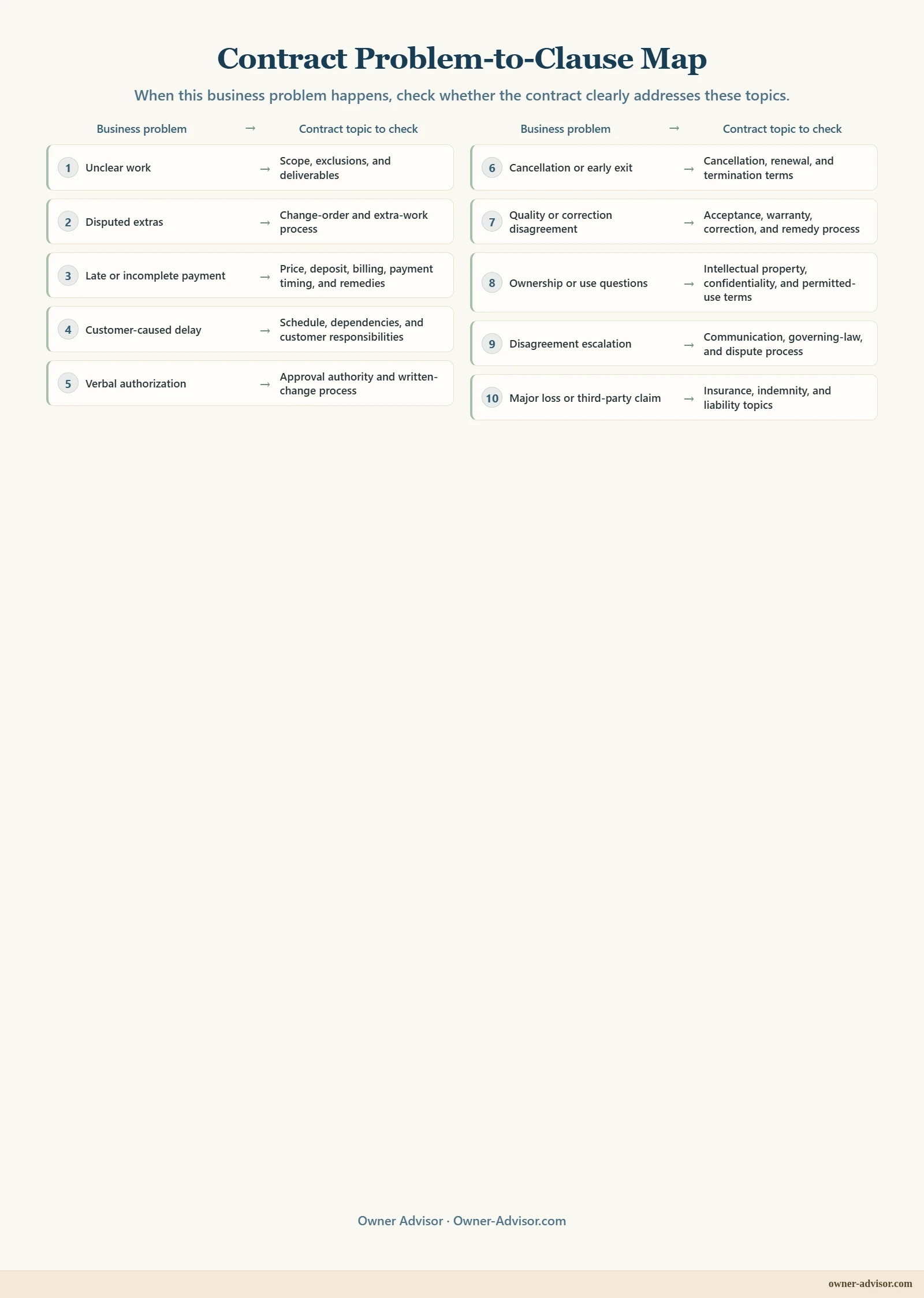
| Business problem | Contract topic to check |
|---|---|
| 1. Unclear work | Scope, exclusions, and deliverables |
| 2. Disputed extras | Change-order and extra-work process |
| 3. Late or incomplete payment | Price, deposit, billing, payment timing, and remedies |
| 4. Customer-caused delay | Schedule, dependencies, and customer responsibilities |
| 5. Verbal authorization | Approval authority and written-change process |
| 6. Cancellation or early exit | Cancellation, renewal, and termination terms |
| 7. Quality or correction disagreement | Acceptance, warranty, correction, and remedy process |
| 8. Ownership or use questions | Intellectual property, confidentiality, and permitted-use terms |
| 9. Disagreement escalation | Communication, governing-law, and dispute process |
| 10. Major loss or third-party claim | Insurance, indemnity, and liability topics |
- 1
Unclear work
Contract topic to check
Scope, exclusions, and deliverables
- 2
Disputed extras
Contract topic to check
Change-order and extra-work process
- 3
Late or incomplete payment
Contract topic to check
Price, deposit, billing, payment timing, and remedies
- 4
Customer-caused delay
Contract topic to check
Schedule, dependencies, and customer responsibilities
- 5
Verbal authorization
Contract topic to check
Approval authority and written-change process
- 6
Cancellation or early exit
Contract topic to check
Cancellation, renewal, and termination terms
- 7
Quality or correction disagreement
Contract topic to check
Acceptance, warranty, correction, and remedy process
- 8
Ownership or use questions
Contract topic to check
Intellectual property, confidentiality, and permitted-use terms
- 9
Disagreement escalation
Contract topic to check
Communication, governing-law, and dispute process
- 10
Major loss or third-party claim
Contract topic to check
Insurance, indemnity, and liability topics
Who are the parties, and who can sign?
Identify the full legal names of the parties, their business entities, addresses, and authorized signers.
Do not rely only on a trade name.
The customer may know the company as "Smith Plumbing," while the legal entity is "Smith Mechanical Services LLC." If the agreement names the wrong party, collecting payment or enforcing the contract can become harder.
Also confirm that the person signing has authority to bind the company.
Is the scope clear enough to price and deliver?
The scope should describe what will be sold, built, delivered, or performed.
Include specific services or products, quantities and specifications, deliverables, location, customer selections, assumptions, exclusions, and acceptance standards.
A contractor should not write only "remodel kitchen." The agreement may need to address demolition, fixtures, permits, disposal, customer-supplied materials, finish assumptions, and excluded work.
A service firm should not promise "marketing support" without defining channels, deliverables, approval responsibilities, meeting limits, and reporting.
A vague scope makes it difficult to tell whether a request is included work or an additional service.
Do the payment terms match the cash demands of the work?
The agreement should explain total price or pricing method, deposit, progress payments, invoicing dates, retainage, payment deadline, reimbursable costs, taxes, late-payment consequences, and conditions for final payment.
For time-and-material work, define rates, minimum charges, markups, and how costs will be documented.
For fixed-price work, state the assumptions supporting the price and what can create an additional charge.
A contractor who pays for materials, labor, and subcontractors months before final payment may be financing the customer's project. The payment schedule should reflect when the business must spend cash.
What should happen when the work changes?
Changes are one of the most common causes of lost margin.
The contract should identify who may request a change, who may approve it, how the price will be calculated, how the schedule may change, whether work may begin before written approval, and how urgent changes are documented.
A customer may casually ask, "Can you add this while you are here?" That request can create extra labor, material cost, scheduling pressure, and warranty exposure.
A practical rule is: changed work requires changed price, changed time, or both.
What happens when the customer causes a delay?
Customer responsibilities may include site or system access, accurate information, selections, approvals, customer-supplied materials, permits assigned to the customer, safe working conditions, coordination with other vendors, and payment.
If the customer delays a selection, blocks access, or fails to provide required information, explain how the schedule and price may be affected.
The business cannot fully control delivery if the agreement ignores dependencies controlled by the customer.
Who owns the work, information, and materials?
Ownership terms matter when the work involves designs, drawings, photographs, reports, software, data, templates, methods, customer lists, or confidential information.
A professional-service firm may transfer the final deliverable while retaining its methods, tools, and reusable templates.
A contractor may want to photograph the finished work for marketing, while the customer expects the property or project to remain private.
Clarify what is owned by each party, what may be reused, and what must remain confidential.
Which risk terms need the most caution?
Warranty, indemnity, insurance, and liability provisions can shift substantial financial risk.
Warning signs include terms that require the business to cover losses beyond its own work, promise results the business cannot control, create unlimited liability, conflict with available insurance, extend warranties beyond supplier or manufacturer coverage, require coverage the business does not carry, or make the business responsible for another party's negligence.
For example, a small subcontractor may be asked to indemnify a general contractor for claims caused partly by the general contractor's own actions. That single sentence can shift far more risk than the subcontract price would ever justify and may not be fully covered by the subcontractor's insurance.
These provisions should not be copied casually from another company's contract.
A clause written for a software vendor may be inappropriate for a roofer. A clause written for a general contractor may expose a small subcontractor to risks it cannot insure.
Use an attorney when these provisions are material.
Can either side end the agreement cleanly?
The contract should explain termination for breach, termination for nonpayment, termination for convenience if allowed, required notice, opportunity to correct a breach, payment for completed work, payment for committed materials, return of property or information, and obligations that continue after termination.
For example, if a customer cancels after custom materials have been ordered, the agreement should explain who pays for those commitments.
Without a clear exit process, the parties may know the relationship has failed but not know how to stop without creating another dispute.
How will disputes be handled?
The agreement may address notice requirements, escalation steps, negotiation, mediation, arbitration, court location, governing law, attorney-fee provisions, and deadlines for claims.
Do not assume arbitration is always faster, cheaper, or better. The right process depends on the transaction, amount at risk, location, and type of disagreement.
The dispute process should be reviewed before a dispute exists — not after the parties are already fighting.
When should an attorney review the agreement?
Legal review becomes more important when the amount at risk is substantial, the customer supplies the contract, ownership or intellectual property is involved, the agreement creates a multiyear obligation, broad indemnity or liability terms appear, regulated or licensed work is involved, employees or subcontractors create additional exposure, work crosses state lines, or the deal is unusual or difficult to reverse.
A template may help organize familiar business terms. It cannot determine whether those terms fit the transaction, applicable law, licensing rules, or available insurance.
What should you check before signing?
Ask:
- Is the scope specific enough to price and deliver?
- Are exclusions clear?
- Does the payment schedule match the cash demands?
- Is there a written change process?
- Are customer responsibilities stated?
- Can delays change the price or schedule?
- Are ownership and confidentiality clear?
- Do risk terms match the business's insurance?
- Is there a workable termination process?
- Are all exhibits and referenced documents attached?
If the written agreement does not match what was discussed, correct it before signing.
What kind of help do you need next?
Owner Advisor is being built to help owners connect contract terms with pricing, cash, workload, customer risk, and operating decisions.
It can help an owner recognize questions such as whether payment timing creates cash pressure, whether a scope is difficult to deliver profitably, or whether a customer obligation is missing.
Owner Advisor is in development and is not available for purchase yet. It does not review contracts for legal sufficiency or replace an attorney. When enforceability, state law, indemnity, ownership, employment, licensing, or material legal exposure is involved, use a qualified attorney.
Key takeaways
- If unpaid extra work is common, strengthen the scope and change-order process.
- If customer delays create cost, define responsibilities and schedule adjustments.
- If payment arrives after most costs are incurred, reconsider deposits and milestones.
- If one clause could create a major uninsured loss, get legal review before signing.
- If the relationship becomes unworkable, the termination section should explain how it ends.
- A good contract makes the business deal clearer; it does not eliminate the need for judgment or legal advice.
Related guides and resources
Snapshot, Signal, and Owner Advisor are not open for purchase yet. Free Business Guides, Free Business Tools, the Business Owner FAQ, and the Monthly Owner Guide are available today.
Owner Advisor Business Guides are educational and practical. They do not replace legal, tax, accounting, HR, insurance, lending, or regulatory advice. Learn more about how we create and review our guides.
Browse Free Business Guides or read the Business Owner FAQ for what is available today.