

A good lead is waiting for follow-up
See who owns the next action instead of relying on memory, inboxes, or someone assuming another person handled it.
Free Lead-to-Cash Handoff Checklist
A quote waits on follow-up. An approved job is still missing a deposit. Scheduling thinks someone else owns the next step. Completed work sits too long before the invoice goes out.
This checklist gives each lead or job a clear stage, current owner, and next action so you can keep it visible through payment and follow-up.
Free Excel checklist. No account required. Anything you download is yours to keep.
Created by Josh Keller, CFO and business owner, for owner-led businesses.
Customer commitment: Installed within 2 business days of approval Status: In progress Exception: None
The sale is not the end of the path. The work still has to be made ready, scheduled, completed, invoiced, collected, and followed up on. The checklist helps make sure each next step has an owner.
Fictional illustrative example.
When this helps
You do not need another complicated system. You need enough visibility to see where an active lead or job stands and what is supposed to happen next.
See who owns the next action instead of relying on memory, inboxes, or someone assuming another person handled it.
Keep missing authorization, deposits, customer information, or internal handoffs visible before they create a delay.
Keep the job visible until billing, collection, and follow-up are actually complete.
What you get
Follow up to 25 leads or jobs through the same ten-stage path and record the information needed to keep each one moving.
See what's inside
The workbook has three sheets, each with a specific purpose.

See a completed record before adding your own work.
The fictional example shows how the stage, owner, next action, customer commitment, notes, and exception fields work together.

Track the stage, owner, status, next action, due date, missing information, customer commitments, handoff notes, exceptions, and completion for up to 25 leads or jobs.
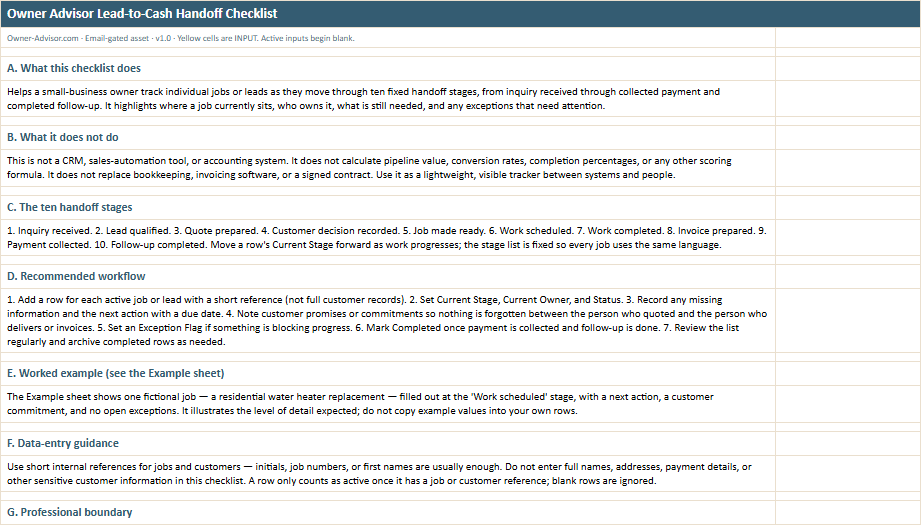
Use the checklist alongside the customer, estimating, scheduling, invoicing, and bookkeeping tools you already rely on.
Ten-stage handoff path
All names, amounts, dates, businesses, and scenarios shown in the previews are illustrative.
Start with active work
Start with the leads and jobs that are easiest to lose track of.
The goal is not to document every conversation. It is to make sure the next important action has an owner.
Add the lead or job.
Use a job number, name, or other reference your team already recognizes.
Record where it stands and who owns it.
Choose the current stage, identify the current owner, and write down the next meaningful action.
Keep it visible until the path is finished.
Do not stop because the quote was approved or the field work ended. Keep following the item through invoicing, collected payment, and final follow-up.
Checklist details
Related resources
These resources help when the checklist shows that the problem is happening earlier in sales or across the broader marketing and sales process.
Find the first meaningful stage where good opportunities are being lost before spending more money generating leads.
Common questions
It helps you see where an individual lead or job currently stands, who owns the next step, what needs to happen, what may be missing, and whether the item has actually made it through payment and follow-up.
No. It is a lightweight handoff checklist for keeping ownership and next actions visible. It does not replace a CRM, customer database, or sales-automation system.
No. It helps you track individual leads and jobs through the operating path. It does not calculate pipeline value, conversion rates, completion percentages, forecasts, or performance scores.
The workbook uses the same ten-stage path for consistency. For each lead or job, record the stage that best describes where it currently sits.
The person responsible for moving that lead or job to its next meaningful step. That person may change as the work moves through sales, estimating, scheduling, field work, billing, collection, and follow-up.
Because a handoff can look complete inside the business while the customer is still waiting for something you already promised. Recording the commitment helps the next owner understand what the customer expects.
Record the status, next action, and appropriate exception instead of allowing the item to disappear into messages, notes, or memory.
No. It helps you keep the handoffs between those activities visible. It does not replace your CRM, estimating system, invoicing software, bookkeeping system, contracts, or professional requirements.
A lead can be lost before the quote.
A sold job can stall before scheduling.
Completed work can wait too long for an invoice.
And an invoice is not cash until the customer actually pays it.
A simple handoff checklist keeps the next action visible until the entire path is complete.
Operating handoff checklist only; not a CRM, sales forecast, or legal compliance tool. Confirm contract, payment, safety, and regulated-work requirements with qualified professionals.
Enter your email and we'll send you the checklist. No account required. Anything you download is yours to keep.