

You know what you want to buy, but not what the debt does to monthly cash
Put the payment, added costs, current cash generation, and cash reserves in the same conversation before deciding the payment is comfortable.
Free Debt Readiness Checklist
A loan can solve an immediate problem and still create a monthly obligation that the business has to carry long after the money arrives.
Before deciding the payment fits, it helps to understand what has to go right each month, what assumptions you are making, and what questions still need answers.
The checklist gives you 21 borrowing-readiness topics, a simple breakeven-volume check, 15 questions to ask the lender, and a place to identify what should be reviewed with your accountant and other qualified professionals before signing.
Free Excel checklist. No account required. Anything you download is yours to keep.
Created by Josh Keller, CFO and business owner, for owner-led businesses.
The Breakeven Helper adds the monthly payment and added operating costs, then divides that amount by the cash remaining after direct costs per job or unit. It rounds the result up when necessary.
This does not tell you whether you should borrow or whether a lender will approve you. It gives you one practical way to see what the new monthly obligation would require from the business.
Fictional illustrative example.
When this helps
Put the payment, added costs, current cash generation, and cash reserves in the same conversation before deciding the payment is comfortable.
Work through the major readiness topics so you can see what is ready, what information is still missing, and what needs professional review.
Ask about total cost, fixed or variable rates, prepayment penalties, collateral, personal guarantees, balloon payments, reporting requirements, default conditions, and other terms that can matter after the loan closes.
Identify the terms, numbers, and business assumptions that still need to be confirmed with the lender, accountant, attorney, or other appropriate professional.
What you get
The Readiness Checklist covers 21 areas including the purpose and amount of the financing, revenue and seasonality, profit and cash flow, existing obligations, personal guarantees, collateral, payment structure, interest-rate type, total financing cost, fees and prepayment penalties, monthly payment affordability, breakeven volume, alternatives, credit history, financial statements, tax returns, backup repayment plans, cash reserves, and professional review.
Each topic can be marked:
Those labels describe how ready you are to discuss the topic. They do not mean approved, eligible, safe, compliant, or qualified.
Not reviewed · Information needed · Ready to discuss · Professional review needed · Not applicable
See what's inside
The file has five sheets.
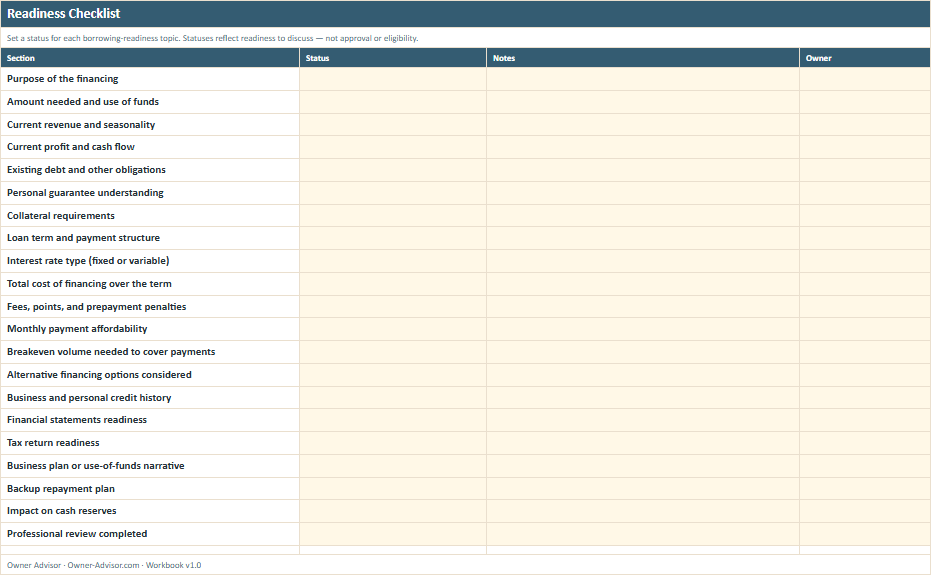
See what is ready for discussion and what still needs work.
Review 21 fixed borrowing topics and record the status, your notes, and who owns the next step.
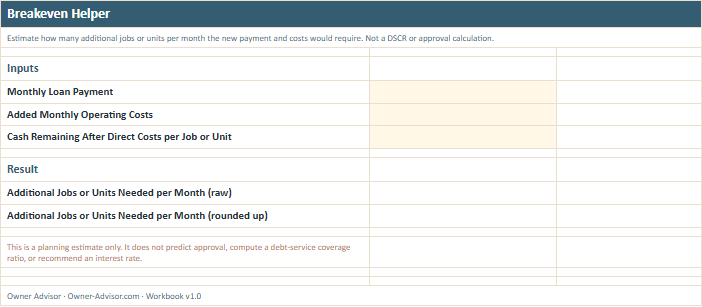
Enter the expected monthly loan payment, added monthly operating costs, and cash remaining after direct costs per job or unit. The helper shows the calculated additional jobs or units and a rounded-up planning number. If the inputs are incomplete or the cash-remaining amount is zero, it shows Cannot calculate rather than inventing a result.
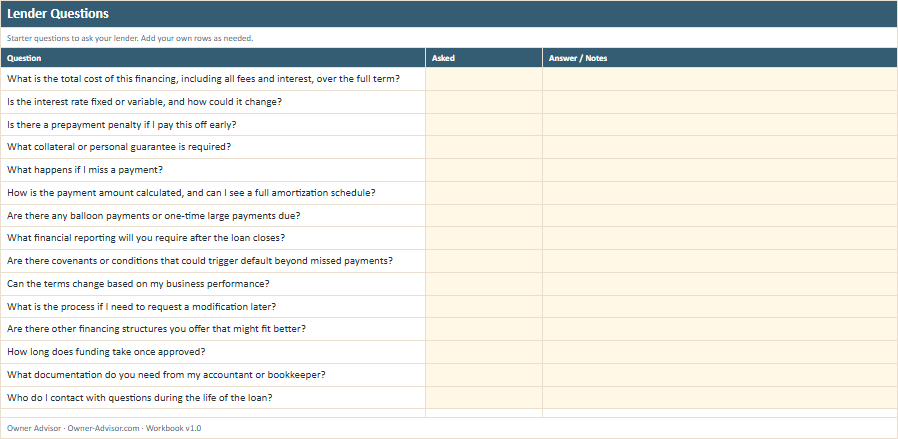
The sheet contains 15 starter questions covering topics such as total financing cost, rate changes, prepayment penalties, guarantees and collateral, missed payments, amortization, balloon payments, reporting requirements, default conditions, modifications, funding timing, and required documentation.
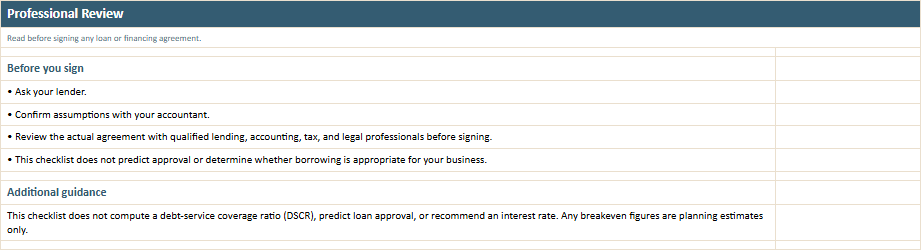
The sheet directs you to ask the lender, confirm assumptions with your accountant, and review the actual agreement with qualified lending, accounting, tax, and legal professionals.
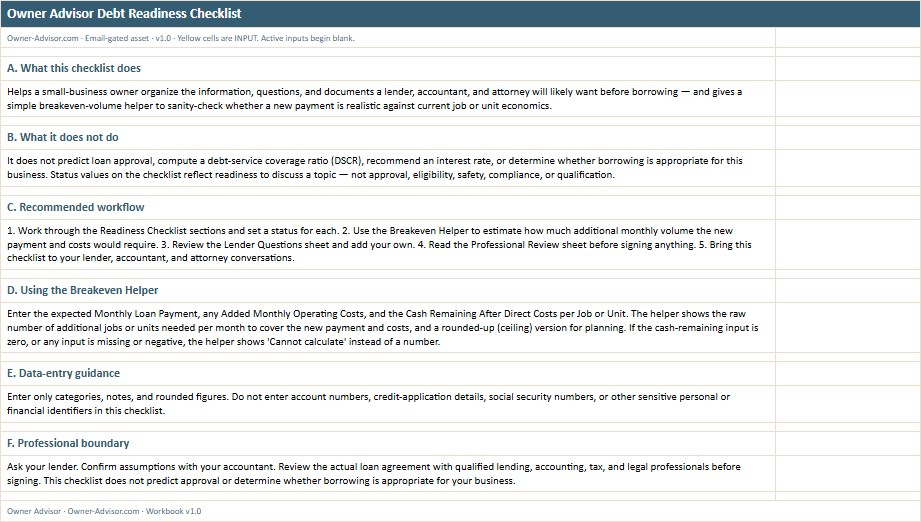
Work through the readiness topics, use the breakeven helper, prepare your lender questions, and bring the resulting questions into the appropriate professional conversations.
All names, amounts, dates, businesses, and scenarios shown in the previews are illustrative.
Start with the reason you are considering the debt
The goal is not to make the loan look better. It is to understand the obligation before you take it on.
Write down why you need the financing.
Clarify the amount, intended use, and what the financing is expected to change in the business.
Work through the readiness checklist.
Mark what you already understand, what information is missing, and what needs professional review.
Test the monthly payment against the business.
Use the Breakeven Helper to see how much additional monthly work would be needed to cover the new payment and added operating costs.
Take the unanswered questions into the financing conversation.
Ask the lender about the actual terms and confirm the important business, accounting, tax, and legal assumptions before signing.
Checklist details
Related resources
If you are considering debt because cash is tight, start with the cash-flow guide. If you are preparing financial information for the financing conversation, start with the monthly-reporting guide.
Walk through whether borrowed money is the right next move before treating a lender conversation as the decision.
Understand what may be absorbing cash before adding another monthly obligation.
Strengthen the financial information behind the financing conversation and understand the monthly statements a lender or accountant may ask you to review.
No. It does not predict approval or calculate eligibility. The checklist statuses only show whether a topic is ready for discussion, still needs information, or needs professional review.
No. The workbook deliberately does not calculate a debt-service coverage ratio.
No. It performs one narrower calculation: how many additional jobs or units would be needed each month to cover the expected loan payment and added operating costs using the cash remaining after direct costs per job or unit. It does not determine whether borrowing is appropriate.
No. It does not recommend lenders or tell you what interest rate to accept.
The workbook gives you 15 starters covering total financing cost, rate type, early payoff, collateral and guarantees, missed payments, amortization, balloon payments, financial reporting, default conditions, changes to the terms, modification options, other financing structures, funding timing, documentation, and who to contact later.
No. Use categories, notes, and rounded figures. Do not enter account numbers, credit-application details, Social Security numbers, or other sensitive personal or financial identifiers.
It means you have enough information to have the conversation about that topic. It does not mean the financing is approved, safe, compliant, appropriate, or financially advisable.
Ask your lender. Confirm assumptions with your accountant. Review the actual agreement with qualified lending, accounting, tax, and legal professionals before signing.
Educational readiness aid only; does not predict approval, recommend lenders, or determine whether borrowing is appropriate. Ask your lender and confirm with your accountant.
Know why you need the money.
Know what the payment adds each month.
Know what assumptions still need checking.
Know what to ask before you sign.
Enter your email and we'll send you the checklist. Anything you download is yours to keep.