

The business is making more money and somebody suggested looking at an S corporation
Instead of treating higher profit as the answer, use the worksheet to identify the other parts of the decision that still need to be discussed.
Free S Corporation Decision Worksheet
Maybe the suggestion came from your accountant. Maybe another business owner mentioned it. Maybe you have simply reached the point where the business is making more money and you are wondering whether the current setup still makes sense.
What sounds like a tax decision can quickly turn into questions about ownership, payroll, compensation, administration, cash, state treatment, and what the business may look like a few years from now.
Seven fit areas give you a better conversation — not a score.
The S Corporation Decision Worksheet helps you describe the business as it exists today, work through the parts of the decision that still need attention, prepare questions for the appropriate professionals, and gather the documents they may need.
It does not calculate tax savings, determine eligibility, or recommend making an S corporation election.
Free Excel worksheet. No account required. Anything you download is yours to keep.
Created by Josh Keller, CFO and business owner, for owner-led businesses.
That is exactly what the worksheet is designed to make visible.
The thing to notice is not the Strong result.
It is everything that is still unanswered around it.
A profitable business may be worth discussing with your accountant, but profit alone does not answer what compensation should look like, what payroll and administration would cost, whether ownership fits the requirements, or whether the overall economics still make sense after everything is considered.
The worksheet keeps those questions next to one another so one encouraging factor does not quietly become the whole decision.
Fictional illustrative example.
When this helps
Instead of treating higher profit as the answer, use the worksheet to identify the other parts of the decision that still need to be discussed.
Put those questions in front of your accountant, tax adviser, and payroll provider before assuming the election is simply a different way to file taxes.
Record the current entity, owners, states of operation, and planned ownership changes so the accountant and attorney can review the situation you actually have.
Keep state-specific questions visible rather than assuming the federal election settles everything everywhere the business operates.
What you get
The Current Situation sheet gives you one place to describe the background behind the decision: your entity type, states of operation, number of owners, owner involvement, current and prior profit trends, payroll setup, professional contacts, why you are considering the election, and your target timeline.
Then the worksheet helps you work through seven areas:
Each area can be marked Weak, Mixed, Strong, or Not reviewed, with room for notes. Those values are deliberately not converted into points or a recommendation. A business decision like this depends on your actual tax situation, ownership, compensation, state treatment, administrative cost, and professional advice—not a generic spreadsheet formula.
Before you put information in the file
Use plain business descriptions, notes, and document names.
Do not enter account numbers, Social Security numbers, or other sensitive identifiers.
The worksheet should tell you what you need to gather or discuss. Sensitive source documents should remain in the appropriate place rather than being copied into the spreadsheet.
See what's inside
The file has five sheets.
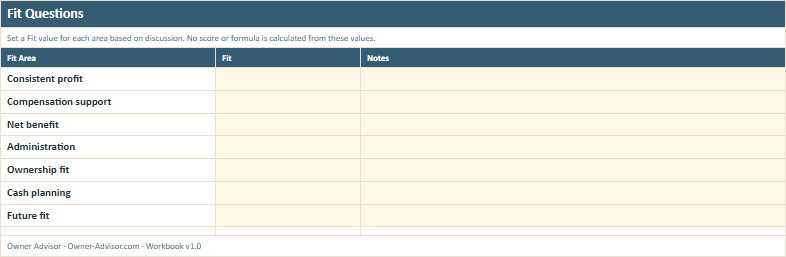
See the seven parts of the decision together without turning them into a fake score.
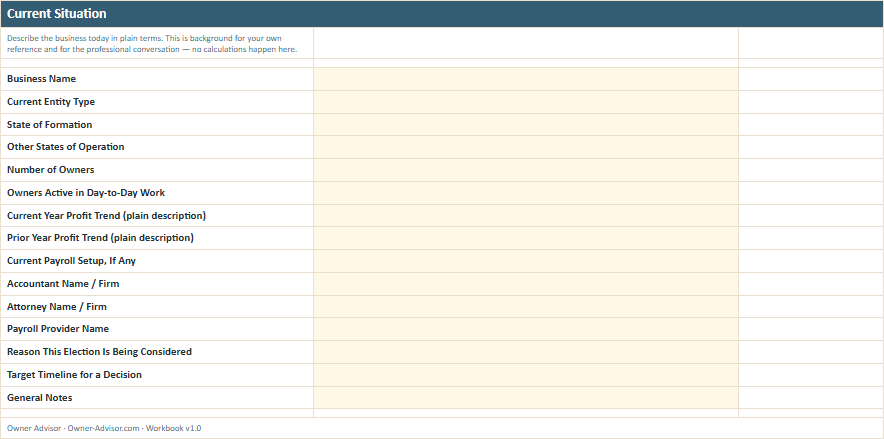
Record the entity, states of operation, owners, profit trends, payroll setup, professional contacts, reason for considering the election, timeline, and general notes.
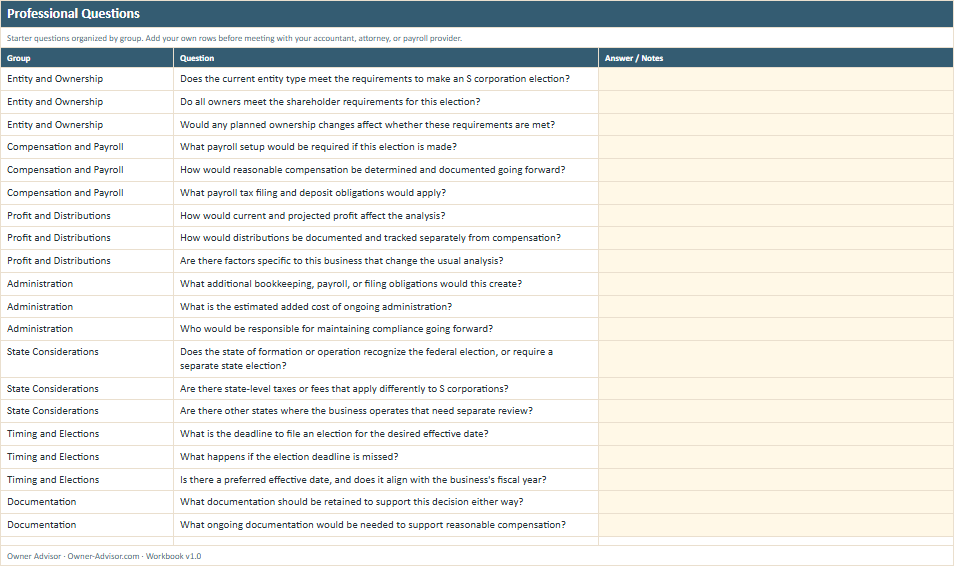
The starter questions cover entity and ownership, compensation and payroll, profit and distributions, administration, state considerations, election timing, and documentation. Use the answer and notes column to keep the professional guidance tied to the question that produced it.
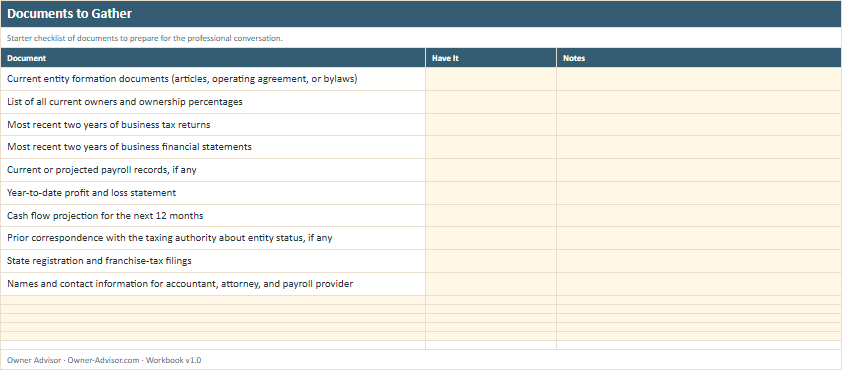
The starter list includes entity documents, ownership information, recent business tax returns and financial statements, payroll information if applicable, a year-to-date profit and loss statement, a cash-flow projection, relevant tax-authority correspondence, state filings, and professional contact information. Mark what you have, what is missing, and anything that needs follow-up.
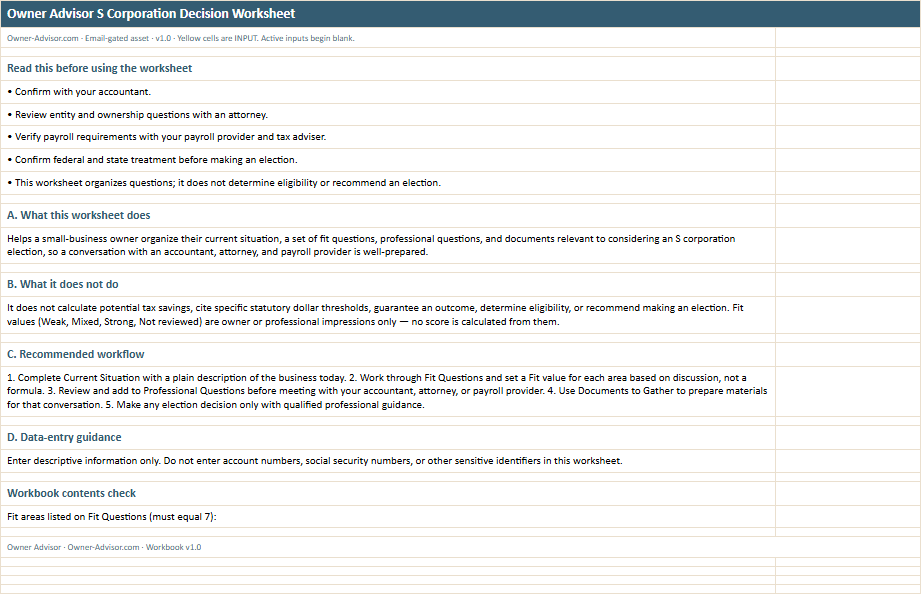
The instructions explain the workflow, the role of the fit values, which professionals may need to be involved, and what information should not be entered into the file.
All names, amounts, dates, businesses, and scenarios shown in the previews are illustrative.
Start with the business you have today
The goal is not to make the election look good or bad. It is to make sure one appealing part of the idea does not become the answer before the rest of the decision has been reviewed.
Complete Current Situation.
Put the basic entity, ownership, profit, payroll, and state context in one place.
Work through the seven fit areas.
Mark what looks clear and leave Not reviewed where you still need an answer.
Prepare the professional questions.
Start with the workbook prompts, then add the questions specific to your business.
Gather the documents.
See what you already have and what should be collected before the professional conversation.
Worksheet details
Related Business Guide
The Owner Advisor guide What Is an S Corporation, and Should My Small Business Consider One? explains the decision in owner language, including what the election changes, what it does not change, and why profit alone is not the answer. Use the guide when you want the background. Then use this worksheet to organize the business facts, fit questions, professional questions, and documents for your accountant and attorney.
No. Eligibility depends on the actual entity, ownership, and applicable requirements. Use the worksheet to organize those questions for your accountant and attorney.
No. Your accountant or tax adviser should evaluate the actual tax consequences using current law and your business information.
No. Weak, Mixed, Strong, and Not reviewed are discussion impressions only. They are not points and are never combined into a score.
It flags the compensation and payroll part of the conversation for review. The worksheet does not determine reasonable compensation.
Yes. Record the payroll setup you have today—even if that means none—and use the professional questions to understand what payroll, filings, deposits, and ongoing administration would be required if you make the election.
It gives you questions to raise about state treatment, separate elections, state-level taxes or fees, and other states where the business operates. The answers still need to come from the appropriate professionals.
The workbook starts with ten suggested document categories, including entity and ownership records, recent business tax returns and financial statements, payroll information if applicable, a current profit and loss statement, a cash-flow projection, state filings, and relevant professional or tax-authority information. There is room for up to 15 document rows.
The workbook directs you to confirm the tax analysis with your accountant, review entity and ownership questions with an attorney, verify payroll requirements with your payroll provider and tax adviser, and confirm federal and state treatment before making the election.
Organizes questions for professional review; does not determine eligibility, calculate tax savings, or recommend an S corporation election. Confirm with your accountant and attorney.
Know why you are considering the election.
Know which parts of the decision still need review.
Know what questions to take to the professionals.
Know what documents you still need to gather.
Enter your email and we'll send you the worksheet. Anything you download is yours to keep.